Executive search in Dubai is a research-led way to hire C-suite, VP and director-level leaders. A search firm maps the market, approaches people who are not job hunting, and presents a short, vetted list. Most searches take 10–14 weeks and cost 20–33% of the executive's first-year pay on a retained basis, or 15–25% on contingency.
The model exists because the people you want for a leadership role are rarely applying for jobs. A Cooper Fitch survey of more than 1,000 Gulf organisations, reported by Khaleej Times in December 2025, found that only 50% of executives feel confident in the talent pool. Another 40% believe the market cannot meet their requirements at all.
This guide is for the employer side of the table. It covers how a search runs, what it costs in AED, how long it takes from brief to first day, the UAE rules that shape a senior hire, and how to pick a firm.
What is executive search in Dubai?
Executive search in Dubai is a specialist form of recruitment for senior roles, usually paid well above a standard agency fee. Instead of advertising the job and screening applicants, the search firm builds a list of target companies, identifies the leaders inside them, and approaches those people directly and confidentially. The result is a shortlist of perhaps three to six candidates, most of whom were not looking to move. Firms in Dubai typically handle CEO, CFO, COO, CHRO, commercial and country-manager roles, plus board seats. Two commercial models dominate. In a retained search in Dubai, you pay part of the fee up front and the firm works the mandate exclusively. In a contingency search, you pay only if you hire someone the firm introduced. Executive search differs from ordinary recruitment in three ways: the candidate pool is mostly passive, the firm assesses leadership judgement rather than a skills checklist, and the whole process runs under confidentiality, often while the incumbent is still in the seat.
How does the executive search process work in Dubai?
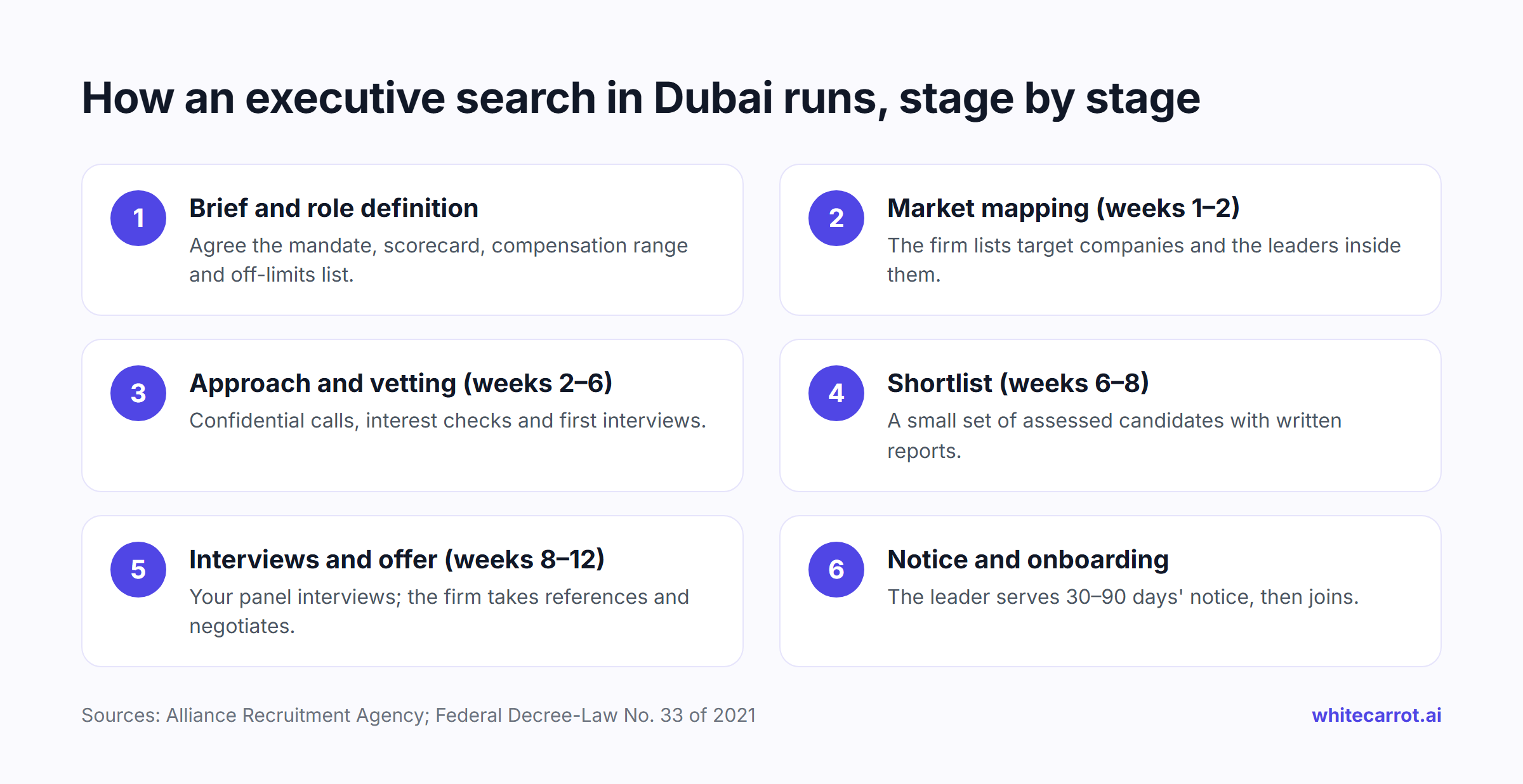
The executive search process in Dubai follows six stages, and the employer has work to do in each one. Guildhall's guide to executive search in Dubai describes the same sequence most firms use: briefing, market mapping, candidate approach, assessment and shortlisting, interviews and offer, then onboarding support. A standard search runs 8–12 weeks by that guide's estimate, and board-level searches that need regulatory approval can take 16–20 weeks. The stages below use the week ranges from Alliance Recruitment Agency's comparison of retained and contingency search.
Brief and role definition. Agree the mandate, the scorecard, the compensation range and the list of companies the firm may not approach.
Market mapping (weeks 1–2). The firm lists target companies and the leaders inside them, often 100 or more names.
Approach and vetting (weeks 2–6). Consultants call candidates confidentially, test interest and run first interviews.
Shortlist (weeks 6–8). You receive a small set of assessed candidates with written reports.
Interviews and offer (weeks 8–12). Your panel interviews, the firm takes references and negotiates the offer.
Notice and onboarding. The chosen leader serves 30–90 days' notice, then joins.
Week ranges from Alliance Recruitment Agency's comparison of retained and contingency search; notice period from UAE Labour Law, Article 43.
The stage that slows most searches is not the search itself but the interview loop. Gaps of weeks between panel rounds give strong candidates time to accept a counter-offer. Fix the interview panel, the structured scorecard and the calendar before the shortlist arrives.
How much does executive search cost in Dubai?
Executive search in Dubai costs between 15% and 33% of the hire's first-year pay, depending on the model. According to Alliance Recruitment Agency's comparison, retained search runs at 25–33% of first-year total compensation, paid in three equal instalments at mandate, shortlist and placement. Contingency search runs at 15–25% of first-year salary and is paid only on placement. Guildhall quotes a slightly wider retained range of 20–33%. Some firms sit outside both models: Keller Executive Search advertises a 15% success fee with a replacement guarantee of up to 365 days. On an AED 600,000 package, those percentages mean a fee of anywhere from AED 90,000 to AED 198,000. Check whether "compensation" in the contract means base salary or total package including bonus and allowances, because in the UAE housing and transport allowances can be a large share of pay.
Model
Typical fee in Dubai
When you pay
Fee on an AED 600,000 package
Guarantee
Retained search
25–33% of first-year total compensation (20–33% in Guildhall's guide)
Three equal payments: at mandate, at shortlist, at placement
AED 150,000–198,000
90 days standard; 6–12 months at leading firms
Contingency search
15–25% of first-year salary
Only when the hire starts
AED 90,000–150,000
Shorter, or none
Success-fee search (example: Keller)
15% success fee
On placement
AED 90,000
Up to 365 days
Fees before VAT. Ranges from Alliance Recruitment Agency (retained 25–33%, contingency 15–25%) and Keller Executive Search (15% success fee).
The three-stage payment is the key difference. On a 33% retained search for that AED 600,000 package, you pay AED 66,000 when you sign, AED 66,000 when the shortlist arrives, and AED 66,000 when the leader accepts. The first two payments are due even if you never hire.
Retained search or contingency: which fits a Dubai leadership hire?
Retained search fits a Dubai leadership hire when the role is confidential, business-critical or hard to fill, and contingency fits when the role is senior but well defined and the market is deep. A retained firm commits senior consultants to one mandate, maps the whole market and is paid for the work, so it has no reason to rush a weak shortlist. A contingency firm is paid only on success, which makes it cheaper when it works but means your role competes with every other open mandate on the consultant's desk. Alliance notes that contingency searches often produce first CVs faster, but take about as long to reach a completed hire at senior level.
Choose retained for CEO, CFO or country-manager roles, replacements for a leader still in post, and any search where only one firm should be calling the market.
Choose contingency for senior functional heads in large talent pools, such as sales or finance directors in Dubai's financial and property sectors.
Run it in-house when your own team already knows the candidates and needs process, not introductions.
How long does leadership hiring in the UAE take, from brief to first day?
Leadership hiring in the UAE takes roughly three to six months from brief to first day once you count the notice period. Search firms quote the time to an accepted offer, which is 10–14 weeks for a retained search according to Alliance. That is only part of the calendar. Under Article 43 of Federal Decree-Law No. 33 of 2021, as Element's 2026 guide to UAE notice periods sets out, a private-sector notice period must be at least 30 and no more than 90 days. Senior employees often sit at the top of that range. Add the two together and a leader you brief for today may not start for 14 to 27 weeks. Plan backwards from the date you need the person in the seat, not from the date you sign the search.
Stage
Typical time
Source
Brief and mandate signed
About 1 week
Your own approvals
Market mapping
Weeks 1–2
Alliance Recruitment Agency
Approach and vetting of candidates
Weeks 2–6
Alliance Recruitment Agency
Shortlist presented
Weeks 6–8
Alliance Recruitment Agency
Client interviews and offer
Weeks 8–12
Alliance Recruitment Agency
Candidate serves notice
30–90 days
UAE Labour Law, Article 43
Brief to first day
Roughly 14–27 weeks (about 3–6 months)
Sum of the rows above
Probation also shapes the risk. In the UAE private sector, probation cannot exceed six months from the start date, which is also the window in which most search guarantees operate. Line the guarantee up with the probation period when you negotiate.
What UAE rules affect an executive hire?
Three UAE rules shape an executive hire in Dubai: Emiratisation targets, statutory notice periods and the six-month probation cap. Emiratisation matters most for planning. According to Zawya's report on MOHRE's targets, private-sector companies with 50 or more workers must increase the share of Emiratis in skilled jobs by 2% a year, with 1% due in each half of the year. A leadership hire is a skilled role, so tell the search firm at the brief whether a UAE national is a requirement, a preference or neither, and ask for evidence of Emirati placements at the right level. The notice period rules above decide the start date. Probation decides how long you have to assess the hire under lighter termination terms, and it should line up with the firm's replacement guarantee.
Emiratisation: 2% a year growth in Emiratis in skilled jobs for companies with 50+ workers.
Notice period: 30–90 days after probation, set by the contract.
Probation: up to six months from the actual start date.
How do you choose an executive search firm in Dubai?
Choose an executive search firm in Dubai on four things: its recent placements at your level in your sector, the consultant who will actually run the search, its off-limits list, and the terms of its guarantee. Dubai has global networks, such as Stanton Chase, which has operated there since 2006, and regional specialists such as Hanson Search, which opened its Dubai office in 2015. Firm size matters less than the individual consultant, so ask to meet the person who will call candidates, not only the partner who pitches. A firm that already places leaders at your competitors may be barred from approaching them, which shrinks your market.
Ask for three recent placements at the same level, in your sector, in the GCC.
Name the lead consultant in the contract, with their time commitment.
Get the off-limits list: which companies the firm cannot approach because they are clients.
Define the fee base: base salary or total package, and whether expenses are capped.
Match the guarantee to probation: six months is a fair ask for a retained search.
Agree reporting: a weekly update with names approached, interested and declined.
Write the role description before the first meeting. A clear brief, even a draft from a job description generator, makes the scorecard and the market map faster to agree.
How Whitecarrot handles leadership hiring
Whitecarrot is a Dubai-based hiring company working with 88+ companies across the GCC. For executive search in Dubai and the wider region, Whitecarrot's executive search service maps the market and builds a tailored shortlist for C-suite, VP and director-level roles across the UAE, Saudi Arabia, Singapore and Hong Kong, under confidential mandates. For senior roles that do not need a full search, Whitecarrot Managed Hiring sends a shortlist within 24 hours, charges one month's salary as its placement fee and backs the hire with a 90-day replacement guarantee. Rent-a-Recruiter puts a recruiter on your roles within 48 hours, with no retainer.
Whichever route you take, the interview loop is where leadership hires are won or lost. The Whitecarrot AI Recruiter schedules panel interviews in Google or Outlook, joins as an AI notetaker, collects structured feedback, then manages the offer through e-signature and HRMS onboarding.
Executive search in Dubai usually costs 25–33% of the executive's first-year total compensation on a retained basis, paid in three instalments at mandate, shortlist and placement. Contingency search costs 15–25% of first-year salary and is paid only on placement. On an AED 600,000 package, that is roughly AED 90,000 to AED 198,000.
How long does executive search take in Dubai?
A retained executive search in Dubai typically takes 10–14 weeks from signed mandate to accepted offer, and board-level searches needing regulatory approval can take 16–20 weeks. Add the candidate's notice period of 30–90 days under UAE labour law, and most leaders start three to six months after the brief.
What is the difference between retained and contingency search?
Retained search is paid partly up front, runs exclusively and commits senior consultants to map the whole market, so it suits confidential or critical roles. Contingency search is paid only when a candidate is hired, costs less, and suits well-defined senior roles in deep talent pools, but the firm gives it less priority.
What is the difference between executive search and recruitment?
Executive search approaches passive senior candidates directly and confidentially, assesses leadership judgement, and usually charges a retainer. Recruitment advertises roles, screens active applicants and charges a fee only on placement. Executive search is used for C-suite, VP and director roles; recruitment for most other permanent hires.
Table of Content
Skip the hiring hassle
See how Whitecarrot helps you source, screen, and hire faster with AI.