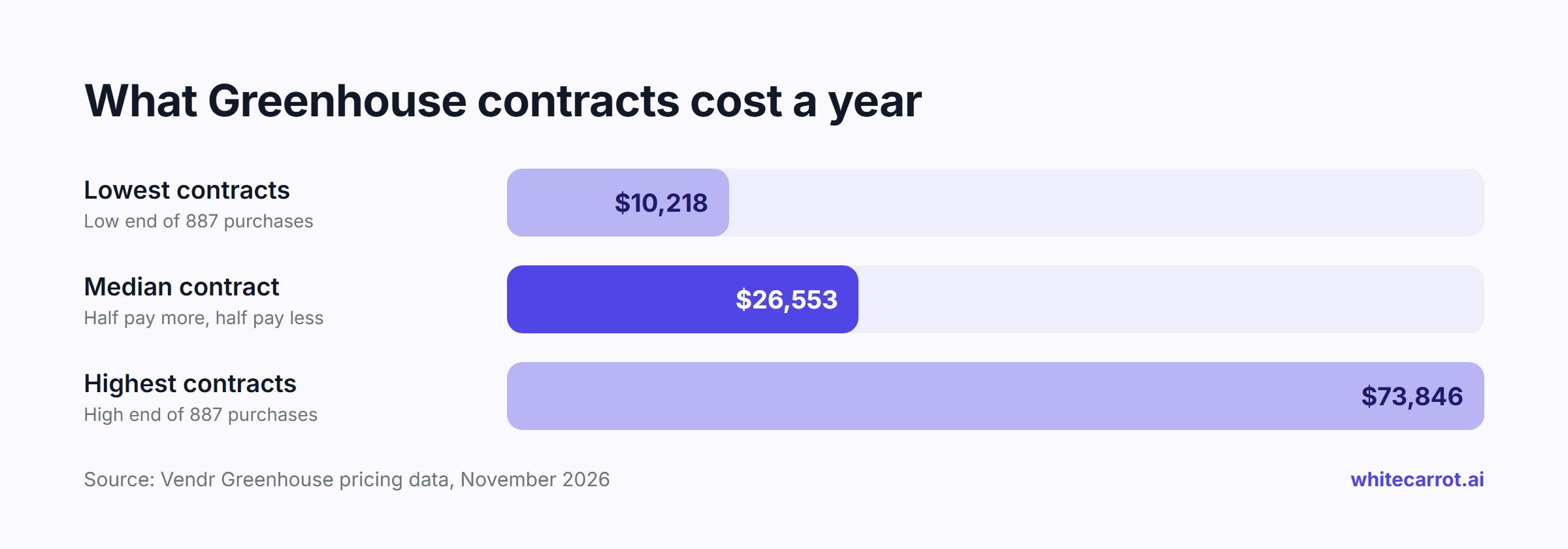
Greenhouse pricing is not published. Greenhouse sells three plans, Core, Plus and Pro, and quotes each one after a demo, according to Greenhouse’s own pricing page. Buyer data from Vendr puts the median Greenhouse contract at $26,553 a year, with deals from $10,218 to $73,846.
So is Greenhouse worth the cost? For a mid-market company with a dedicated recruiting team and a structured interview process, often yes. For a 100-person company hiring 20 people a year, the price and setup effort are harder to justify. This guide breaks down what each Greenhouse plan includes, what real contracts cost, the fees that sit outside the subscription, a fair Greenhouse review, and how Greenhouse alternatives and Greenhouse vs Whitecarrot compare for teams in the UAE, Saudi Arabia, Singapore and Hong Kong.
How much does Greenhouse cost in 2026?
Greenhouse costs about $26,553 a year at the median, based on 887 purchases tracked by Vendr’s Greenhouse pricing data, with the lowest contracts near $10,218 and the highest near $73,846 a year. Greenhouse itself shows no prices. Its pricing page says pricing is customised to your hiring needs and depends on four things: the plan, your hiring volume, your organisational complexity and the features your workflows need. Per-plan estimates exist too. HR.software’s Greenhouse review, updated in September 2026, estimates Core at $5,100 to $8,500 a year, Plus at $15,000 to $40,000 and Pro at $36,000 to more than $70,000. Those per-plan figures are third-party estimates, not list prices, so treat them as a range to test a quote against. Greenhouse offers no free plan or free trial, so the only way to see a real number is to book a demo and ask for a written quote.
Greenhouse publishes no prices. Buyer data from 887 purchases shows the spread.
What do Greenhouse Core, Plus and Pro include?
Greenhouse Core, Plus and Pro build on each other: each plan includes everything in the plan below it and adds more automation, reporting or governance. According to the Greenhouse pricing page, Core already covers the essentials most teams buy Greenhouse for: sourcing and CRM, structured interview kits and scorecards, an AI Notetaker, scheduling, reporting and analytics, SSO and Talent Matching. Plus is aimed at teams that want to optimise a running operation, adding AI-powered report filters, a Business Intelligence Connector, Greenhouse Sourcing Automation, texting, and fraud and spam detection. Pro is for complex organisations and adds unlimited CRM events, enterprise-level data configuration and security, an audit log, and a developer sandbox with sync. The plan comparison also shows auto-reject and auto-advance rules on Plus and Pro only, and resume anonymisation and application limits on Pro only. Greenhouse says you can upgrade your plan at any time.
Plan
What it adds
Who it suits
Core
Sourcing and CRM, structured interview kits and scorecards, AI Notetaker, scheduling, reporting and analytics, SSO, Talent Matching
Teams putting structure into hiring for the first time
Plus
Everything in Core, plus AI-powered report filters, BI Connector, Sourcing Automation, texting, fraud and spam detection, auto-reject and auto-advance
Teams with steady volume that want automation and deeper reporting
Pro
Everything in Plus, plus unlimited CRM events, enterprise data configuration and security, audit log, developer sandbox and sync, resume anonymisation
Large or regulated organisations with governance needs
What drives the price of a Greenhouse quote?
The price of a Greenhouse quote is driven by the plan you choose, how many people you hire, how complex your organisation is and which features you need, according to the Greenhouse pricing FAQ. In practice that means two companies of the same size can pay very different amounts. A company with one brand, one office and 30 hires a year sits near the bottom of the range. A company with several business units, approval chains, multiple career sites and hundreds of hires a year sits near the top. Contract terms move the number as well. Vendr reports that multi-year commitments typically unlock 10% to 25% compared with annual agreements, that buyers save about 16% on average after negotiation, and that contracts often include annual renewal increases of 3% to 7%. A Greenhouse quote is therefore best read as a three-year cost, not a first-year price.
Plan: Core, Plus or Pro. Features like texting, fraud detection and auto-advance need Plus or above.
Hiring volume: more roles and hires push the quote up.
Organisational complexity: business units, brands, offices and approval chains.
Term length: multi-year deals cut the annual price but lock you in.
Renewal escalators: 3% to 7% a year unless you negotiate a cap.
What hidden costs come on top of Greenhouse pricing?
The hidden costs of Greenhouse are the fees that sit outside the subscription, and they can add a meaningful share to the first-year bill. HR.software estimates a one-time implementation fee of $1,000 to $15,000 for onboarding, data migration, training and configuration, billed separately from the licence. It also lists Greenhouse Onboarding as a separate add-on, estimated at $2,500 to $5,000 a year, and notes that contracts are annual. On top of those come the renewal increases of 3% to 7% a year that Vendr reports, and the internal cost of an administrator to configure interview plans, scorecards and integrations. Reviewers repeatedly describe Greenhouse setup as a real project rather than a same-day switch. None of this makes Greenhouse poor value, but a budget built on the licence alone will understate the true cost of ownership by the implementation fee in year one and by the escalator every year after.
Cost item
Typical amount
When you pay it
Subscription
$10,218 to $73,846 a year (median $26,553)
Every year, usually annual contract
Implementation, migration, training
$1,000 to $15,000
Once, at the start
Greenhouse Onboarding add-on
$2,500 to $5,000 a year
Every year, if bought
Renewal increase
3% to 7% a year
At each renewal, unless capped
Internal admin time
Not priced by Greenhouse
Ongoing
How can you negotiate a lower Greenhouse price?
You can negotiate a lower Greenhouse price by giving the sales team a clear timeline, a budget and a credible alternative, and by fixing renewal terms before you sign. Vendr’s Greenhouse negotiation guidance recommends engaging early, timing the purchase near a fiscal quarter-end or year-end, and referencing alternatives such as Lever, Ashby or Workable. It also advises negotiating add-on prices up front even if you will not use them yet, asking for onboarding and training to be bundled rather than itemised, and capping annual increases or tying them to CPI. Renewal talks should start 90 to 120 days before the renewal date. Multi-year terms bring the biggest discount, but only sign one with an exit or scope-adjustment clause, because a team that shrinks or changes hiring model can be left paying for capacity it no longer uses.
Get a written quote for the plan you actually need, not the one demoed.
Bring a competing quote from another ATS or an AI recruiter.
Time the signature for a quarter-end or year-end.
Ask for implementation and training to be bundled in.
Cap renewal increases, or tie them to CPI.
Start renewal talks 90 to 120 days before the term ends.
Six steps to bring a Greenhouse quote down, based on Vendr's negotiation guidance.
Greenhouse review: is it worth the cost?
A fair Greenhouse review starts with what it does well: structured hiring. HR.software’s September 2026 review highlights role-specific scorecards that keep interviews consistent, more than 400 native integrations including Workday, BambooHR, Slack and Zoom, approval workflows and strong security credentials, including SOC 2 Type 2 and ISO 27001. The same review lists the drawbacks: high entry cost with quote-only pricing, separately billed implementation, onboarding sold as an add-on, mandatory annual contracts, and reporting that sometimes needs a raw export to Excel for very specific questions. HR.software rates Greenhouse a strong fit for companies of 51 to 10,000 employees, a medium fit for teams of 11 to 50, and a weak fit for teams without dedicated recruiting staff. Greenhouse is worth the cost when recruiters will use its structure every day. It is harder to justify when the real bottleneck is the hours spent screening CVs and booking interviews.
Worth it if: you have dedicated recruiters, a defined interview process, many integrations to connect, and a budget near the $26,553 median.
Think twice if: you hire fewer than 30 people a year, have no recruiting operations owner, or mainly need screening done faster.
Check first if you are outside North America or the UK: HR.software says native coverage is documented for the US, UK and Canada, and advises other buyers to confirm local compliance support with the vendor.
Is Greenhouse worth it for teams in the GCC and Asia?
Greenhouse is worth it for GCC and Asian teams that already run a mature, structured recruiting function, but the case is weaker for growing companies in Dubai, Riyadh, Singapore or Hong Kong. Three things change the maths outside the US. First, the price is set in US dollars against US benchmarks, while many GCC employers still fill senior roles through agencies, so the ATS is an added cost rather than a replacement. Second, HR.software documents native coverage only for the US, UK and Canada, so buyers should confirm how local requirements such as Emiratisation or Saudisation reporting would be handled. Third, a 100-person company hiring across several countries often lacks the in-house admin time that Greenhouse’s configuration needs. For those teams, the questions to ask are how many hours recruiters spend screening, and whether a tool that does that work would save more than a tool that organises it.
What are the cheaper Greenhouse alternatives?
The cheaper Greenhouse alternatives publish their prices, which makes budgeting simpler. Ashby’s pricing page lists its All-In-One Foundations plan at $400 a month for companies up to 100 employees, with Plus and Enterprise quoted. Workable’s pricing page lists Standard from $299 a month for 1 to 20 employees, with Premier and Enterprise above it, and a 15-day free trial. Manatal’s pricing page lists its Professional plan at $15 per user per month billed yearly, with a 14-day trial. Each of these is a capable applicant tracking system, and each is cheaper than the Greenhouse median for a small team. They still leave screening, scheduling and follow-up to your recruiters. An AI recruiter such as Whitecarrot takes a different route: it does much of that first-round work. Our guide to AI alternatives for ATS software compares the wider field.
Tool
Published price
Free trial
Best for
Greenhouse
Not published; median contract $26,553 a year (Vendr)
None
Mid-market and enterprise structured hiring
Ashby
Foundations $400 a month, up to 100 employees
Not stated
Analytics-led teams
Workable
Standard from $299 a month, 1 to 20 employees
15 days
All-round ATS for SMBs
Manatal
Professional $15 per user per month, billed yearly
Greenhouse vs Whitecarrot: which gives more for the money?
Greenhouse vs Whitecarrot is a choice between paying for a process your recruiters run and paying for work that gets done. Greenhouse organises hiring: interview kits, scorecards and approvals in one system. The Whitecarrot AI recruiter does the first-round work itself. It plans the requisition, posts to job boards and pulls every applicant into one place, scores every CV and runs AI-assessed one-way video screening, schedules interviews through Google or Outlook, joins as an AI notetaker, collects structured feedback and sends offers for e-signature before handing the hire to your HRMS. More than 88 companies across the GCC hire with Whitecarrot, and time to hire has fallen from 45 days to under 20. For teams that would rather not run hiring at all, Managed Hiring delivers a shortlist within 24 hours for a placement fee of one month’s salary, with a 90-day replacement guarantee.
Greenhouse pricing is quote-only, and the realistic budget for most mid-sized companies is $10,000 to $75,000 a year, with about $26,500 as the median, before implementation and renewal increases. Greenhouse earns that price when a dedicated recruiting team will run structured hiring on it every day. If your team is smaller, hires across the GCC or Asia, or loses most of its week to screening and scheduling, compare it against a cheaper ATS with published pricing and against an AI recruiter that does the screening for you.
Frequently Asked Questions
Common questions about this topic answered below.
Does Greenhouse have a free trial or free plan?
No. Greenhouse has no free plan and no free trial. Its pricing page asks buyers to book a demo, after which a Greenhouse expert recommends a plan and gives custom pricing. HR.software’s 2026 review also lists no free plan or trial. Teams that want to try an applicant tracking system before paying can test tools with published trials, such as Workable or Manatal.
How much does Greenhouse cost per employee?
Greenhouse does not publish a per-employee or per-user price. It prices each contract by plan, hiring volume, organisational complexity and features. The best public benchmark is a whole-contract figure: Vendr’s data from 887 purchases shows a median of $26,553 a year, with contracts from about $10,218 to $73,846. Ask for a written quote for your own size.
What is the difference between Greenhouse Core, Plus and Pro?
Core covers structured hiring essentials: sourcing and CRM, interview kits and scorecards, AI Notetaker, scheduling, reporting, SSO and Talent Matching. Plus adds automation and reporting, including a BI Connector, Sourcing Automation, texting and fraud detection. Pro adds enterprise governance: unlimited CRM events, data configuration and security, an audit log and a developer sandbox.
Is Greenhouse too expensive for a small company?
For many small companies, yes. HR.software rates Greenhouse a weak fit for teams without dedicated recruiting staff and a medium fit for companies of 11 to 50 employees. With a median contract of $26,553 a year plus implementation fees, a company hiring a few dozen people a year usually gets better value from an ATS with published pricing or an AI recruiter.
Table of Content
Skip the hiring hassle
See how Whitecarrot helps you source, screen, and hire faster with AI.