Introduction: why choosing the right HR software platform matters in 2026
Managing people is the most complex job in any organization, and doing it with spreadsheets in 2026 is simply leaving money on the table. The right HR software platform can slash administrative overhead, accelerate hiring, and give HR managers real-time visibility into their workforce. Yet with dozens of tools competing for your budget, the decision feels overwhelming.
This guide cuts through the noise. We compare the best HR software options of 2026. covering pricing, honest reviews, must-have features, and how they stack up against specialized tools like applicant tracking systems, so you can make a confident, data-backed choice.
What is an HR software platform?
An HR software platform is an all-in-one digital system that centralizes core people operations: recruitment, onboarding, payroll, performance management, leave tracking, and compliance. Rather than stitching together five separate tools, HR managers get a single source of truth for every employee lifecycle stage.
Modern platforms also layer in AI-powered automation, auto-screening résumés, flagging compliance gaps, and generating workforce reports without manual effort.
HR software vs applicant tracking system: what's the difference?
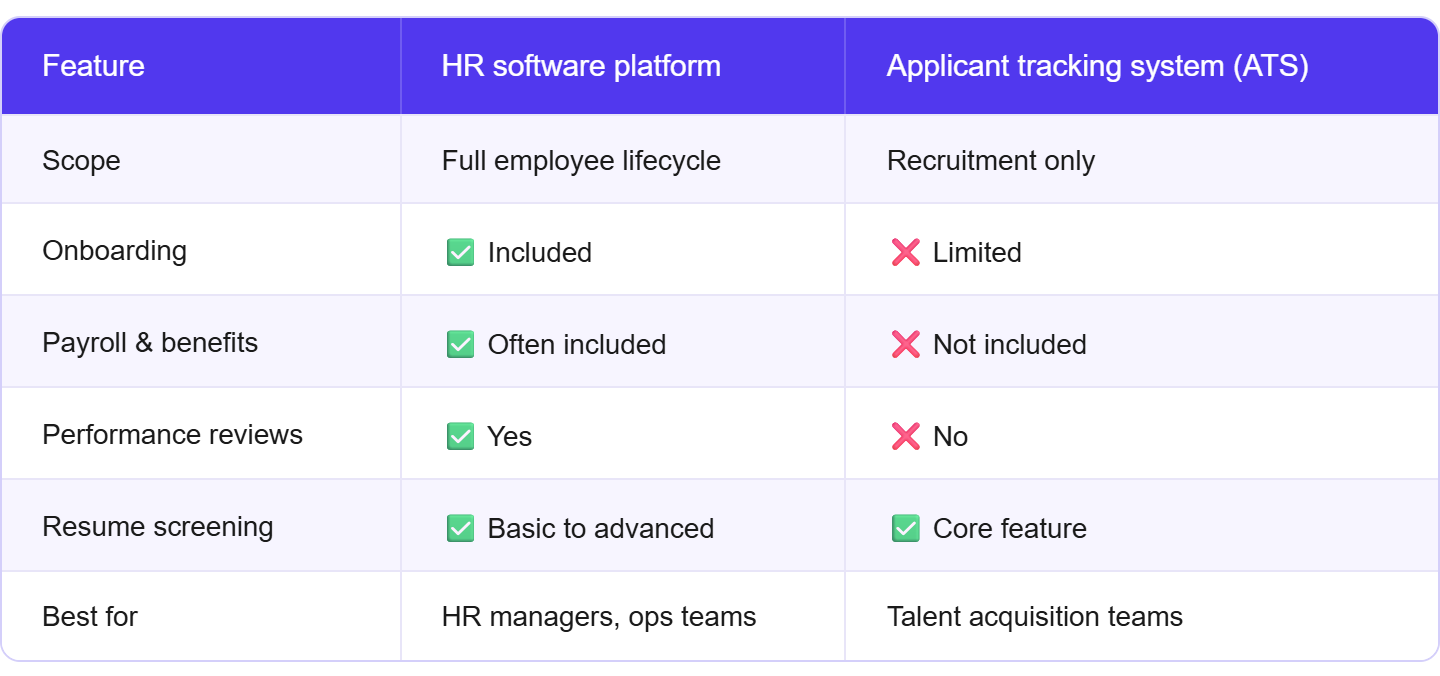
This is one of the most common questions HR managers ask, and the confusion is understandable.
The bottom line: if hiring is your only pain point, a standalone ATS is sufficient. But if you need end-to-end workforce management, a full HR software platform delivers far more value per rupee or dollar spent.
Key benefits of HR software every HR manager should know
Investing in a dedicated platform isn't just about saving time, it drives measurable business outcomes:
Faster hiring cycles - automated job posting and résumé screening reduce time-to-hire by up to 40%
Reduced compliance risk - built-in policy templates and audit trails keep you protected
Better employee experience - self-service portals let employees update details, apply for leave, and access payslips without raising a ticket
Scalability - cloud-based systems grow with your team from 10 to 10,000 employees
Best HR software platforms to consider in 2026
1. Whitecarrot.ai - best for AI-powered hiring and onboarding
Whitecarrot.ai is purpose-built for modern HR and talent teams who want to move fast without sacrificing quality. Its AI co-pilot screens candidates, drafts job descriptions, and automates onboarding workflows, all from one clean interface.
Standout features: AI resume screening, structured interview kits, offer letter automation, background check integrations, and a candidate-facing portal that improves experience scores.
Best for: fast-growing startups, mid-market companies, and enterprise teams that want intelligent hiring at every scale.
2. BambooHR - best for SMBs
BambooHR is a widely-used HR software platform known for its intuitive interface and strong onboarding tools. It covers core HRIS functions well but lacks deep recruiting automation.
HR software pricing: starts at approximately $6–$9 per employee/month (Essential plan).
3. Rippling - best for global teams
Rippling combines HR, IT, and payroll in one platform. It's powerful but can feel complex for teams that just need people management.
HR software pricing: custom pricing; typically starts around $8/employee/month.
4. Workday - best for large enterprises
Workday is the gold standard for enterprise HR software. Its analytics suite is unmatched, but implementation costs and timelines make it impractical for companies under 500 employees.
HR software pricing: enterprise contracts typically start at $100,000+/year.
5. Zoho People - best budget option
Zoho People is a cost-effective HR software platform with solid core features, attendance tracking, leave management, and basic performance reviews, at a fraction of the cost of enterprise tools.
HR software pricing: starts at $1.25/employee/month (Essential HR).
HR software pricing: what should you expect to pay in 2026?
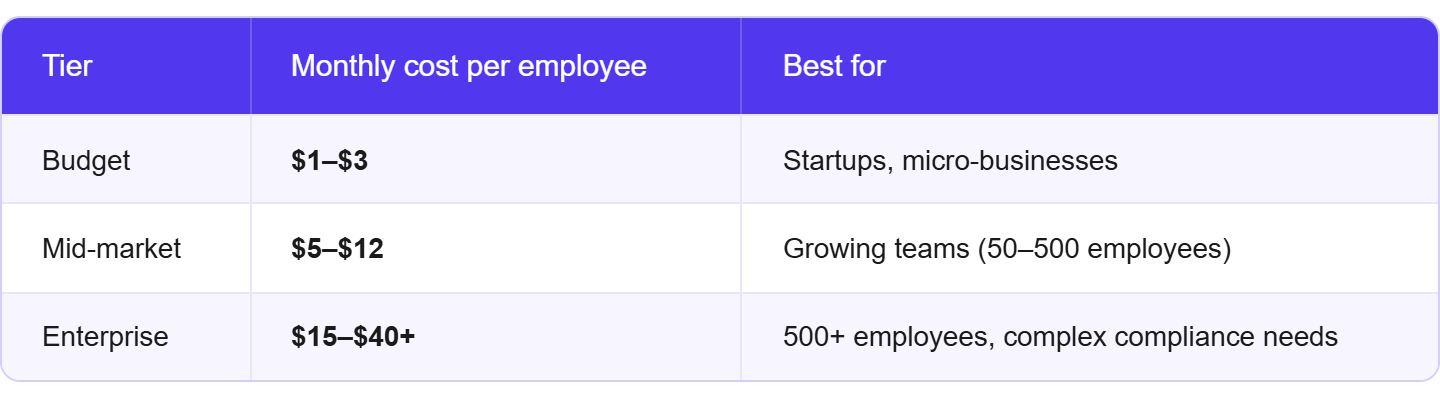
Pricing varies wildly based on team size, feature depth, and contract type. Here's a realistic benchmark:
Watch out for hidden costs - many platforms charge extra for payroll processing, SSO, API access, or advanced analytics. Always request a full pricing breakdown before signing.
Must-have HR software features to look for in 2026
Not all platforms are equal. When evaluating your options, prioritize these core HR software features:
AI-powered candidate screening - filters résumés against your criteria automatically
Integrated onboarding workflows - from offer letter to day-one checklist in one place
Compliance and document management - stores contracts, NDAs, and policy sign-offs securely
People analytics dashboard - tracks attrition, headcount, diversity, and engagement
Payroll integration - syncs with tools like Gusto, ADP, or built-in payroll
Mobile accessibility - HR managers and employees need on-the-go access
API and third-party integrations - connects with Slack, Google Workspace, Jira, and more
Why Whitecarrot.ai is the smartest HR software platform for 2026
The best HR software isn't the one with the most features - it's the one your team will actually use. Whitecarrot.ai was designed from the ground up with HR managers in mind: clean UI, AI-powered automation, and zero fluff.
Here's what sets Whitecarrot apart:
AI co-pilot that writes job descriptions, screens candidates, and drafts offer letters
Live hiring analytics so you always know where bottlenecks live
One-click integrations with 50+ tools your team already uses
Built to scale - works equally well for 10-person teams and 1,000-person orgs
Candidate-first experience that improves your employer brand
What is the best HR software platform for small businesses in 2026?
For small businesses, the best options balance affordability with core functionality. Whitecarrot.ai, Zoho People, and BambooHR are top-rated choices. Whitecarrot is especially strong if hiring is a priority, offering AI-powered screening at a competitive price point.
What's the difference between HR software and an applicant tracking system?
An ATS focuses exclusively on recruitment, sourcing, screening, and tracking candidates. An HR software platform covers the full employee lifecycle including onboarding, payroll, performance, and compliance. If you need both, many modern platforms (like Whitecarrot.ai) include ATS functionality built in.
What are the top benefits of HR software for HR managers?
The top benefits include time saved on admin work, faster and fairer hiring, improved compliance, better employee experience through self-service portals, and access to real-time workforce analytics to make smarter decisions.
Can HR software replace an ATS entirely?
In most cases, yes. A modern HR software platform with robust recruiting features, AI screening, pipeline management, interview scheduling, and offer automation — can fully replace a standalone ATS, often at a lower total cost.
Table of Content
Skip the hiring hassle
See how Whitecarrot helps you source, screen, and hire faster with AI.