Lever pricing is not published. Lever's pricing page lists a core platform and three add-ons with no figures, and every option leads to a quote. According to Vendr's Lever pricing data, based on 321 purchases, the median buyer pays $15,536 a year, with contracts from $6,720 to $51,540. The quote scales with company headcount, not recruiter seats.
That makes Lever hard to budget for before a sales call. This guide sets out what Lever costs in 2026, what the core platform and add-ons include, and how the price grows with headcount. It covers the fees that sit outside the subscription and how buyers negotiate them down. It ends with a fair Lever review and with how Lever alternatives and Lever vs Whitecarrot compare for employers in the UAE, Saudi Arabia, Singapore and Hong Kong.
How much does Lever cost in 2026?
Lever costs about $15,536 a year at the median, according to Vendr, which bases that figure on 321 Lever purchases. The cheapest contracts in Vendr's data sit near $6,720 a year and the largest near $51,540. Lever itself shows no prices. Lever's pricing page says pricing is available on request and scales with team size and hiring needs, and every plan and add-on carries a "Get My Price Quote" button. There is no free plan, and the page offers a demo rather than a free trial. Vendr also reports that buyers who negotiate save 16% on average, so the first quote is rarely the final price. Treat the median as a benchmark to test a quote against, not as a list price. A 50-person company and a 1,000-person company buy the same product at very different prices, because Lever prices on total headcount.
What is included in Lever's core platform and add-ons?
Lever's core platform bundles an applicant tracking system and a recruiting CRM in one product, so recruiters can nurture passive candidates and run live requisitions in the same record. According to Lever's pricing page, every plan includes the core ATS, and the core platform adds reporting dashboards with customisable reports, AI-powered screening and candidate prioritisation, unlimited AI interview transcripts and summaries, and AI fraud-prevention signals. Three add-ons are quoted separately on the same page. Lever is now sold as Lever by Employ: Employ, Inc. owns Lever alongside the JazzHR and Jobvite applicant tracking systems, according to Pin. The add-on list matters for budgeting, because the features many teams assume are standard, such as conversational screening and onboarding, are priced on top.
Candidate Insights: surfaces skills, fit and signals such as assessment and reference data.
AI Screening by VONQ: agent-based chat and voice screening on the career site. Lever went live with it in May 2026, and customers switch it on and then choose which jobs use it, according to ERE's June 2026 report.
Onboarding: automated workflows, task management and document collection for new hires.
How does Lever pricing scale with company headcount?
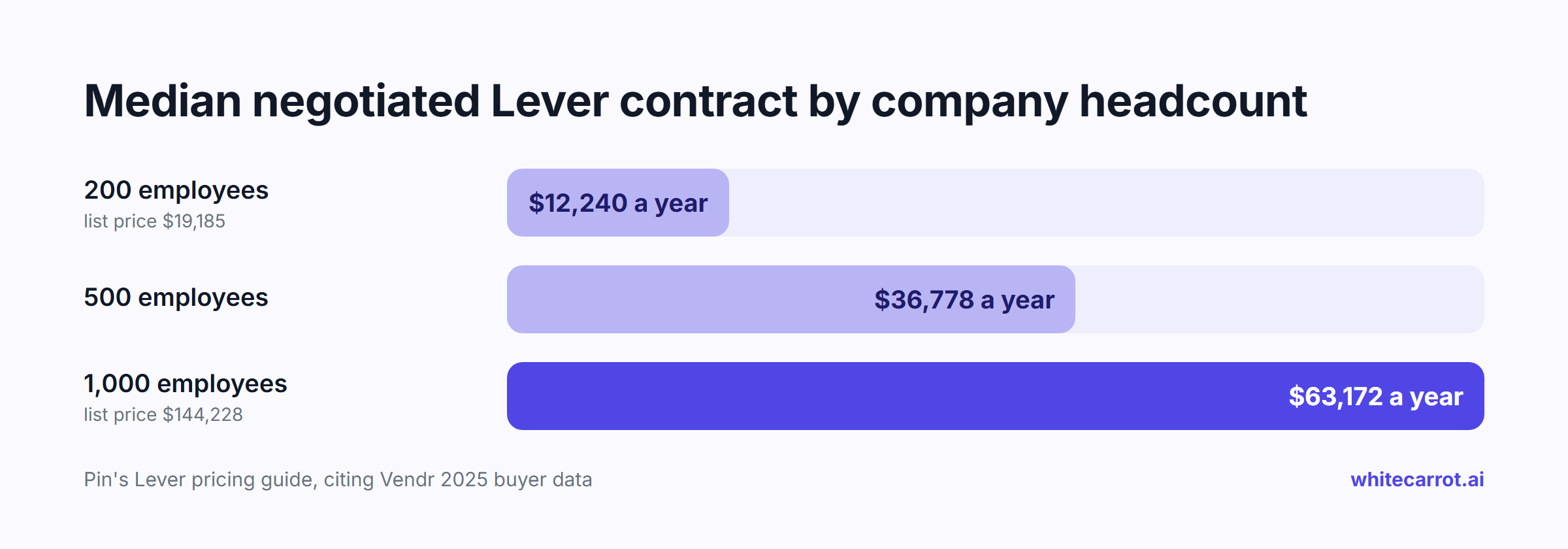
Lever pricing scales with total company headcount, which is the single biggest driver of what you pay. A 500-person company with three recruiters pays for 500 employees, not three users. Pin's Lever pricing guide, citing Vendr's 2025 data, puts the median negotiated contract at $12,240 a year for a 200-person company, against a list price of $19,185. The same source puts it at $36,778 a year at 500 employees and $63,172 a year at 1,000 employees, where the list price was $144,228. Those gaps show how far negotiation moves a Lever deal at scale. They also show the main risk of headcount billing: a company that grows its workforce pays more at renewal even if it hires the same number of people. Pin sells a sourcing tool, and its figures are 2025 data, so use them as a guide to the shape of the curve rather than as quotes.
Lever bills on total company headcount, so the contract grows with the company, not with the recruiting team.
What hidden costs come on top of a Lever subscription?
The hidden costs of Lever are the fees that sit outside the annual subscription: implementation, data migration, add-ons and renewal increases. Pin's guide, citing Vendr, reports implementation quotes of $15,000 to $25,000 that buyers negotiate to $5,000 to $8,000, and data migration from a legacy system at $3,000 to $8,000. Pin sells a sourcing tool and does not give sample sizes, so treat these ranges as estimates to test a quote against. Renewals are the cost buyers forget: Vendr reports annual escalators typically run 3% to 7%, and Pin reports renewal rates running 8% to 15% above new-customer rates. Over a three-year term, those increases can add more than an add-on does.
Implementation: $15,000 to $25,000 quoted, $5,000 to $8,000 negotiated (Pin, citing Vendr).
Data migration: $3,000 to $8,000 from a legacy ATS (Pin, citing Vendr).
Add-ons: Candidate Insights, AI Screening by VONQ and Onboarding, each quoted separately (Lever).
Renewal escalators: typically 3% to 7% a year unless capped in the contract (Vendr).
Payment terms: quarterly or monthly billing can cost 5% to 10% more than annual (Vendr).
How can you negotiate a lower Lever price?
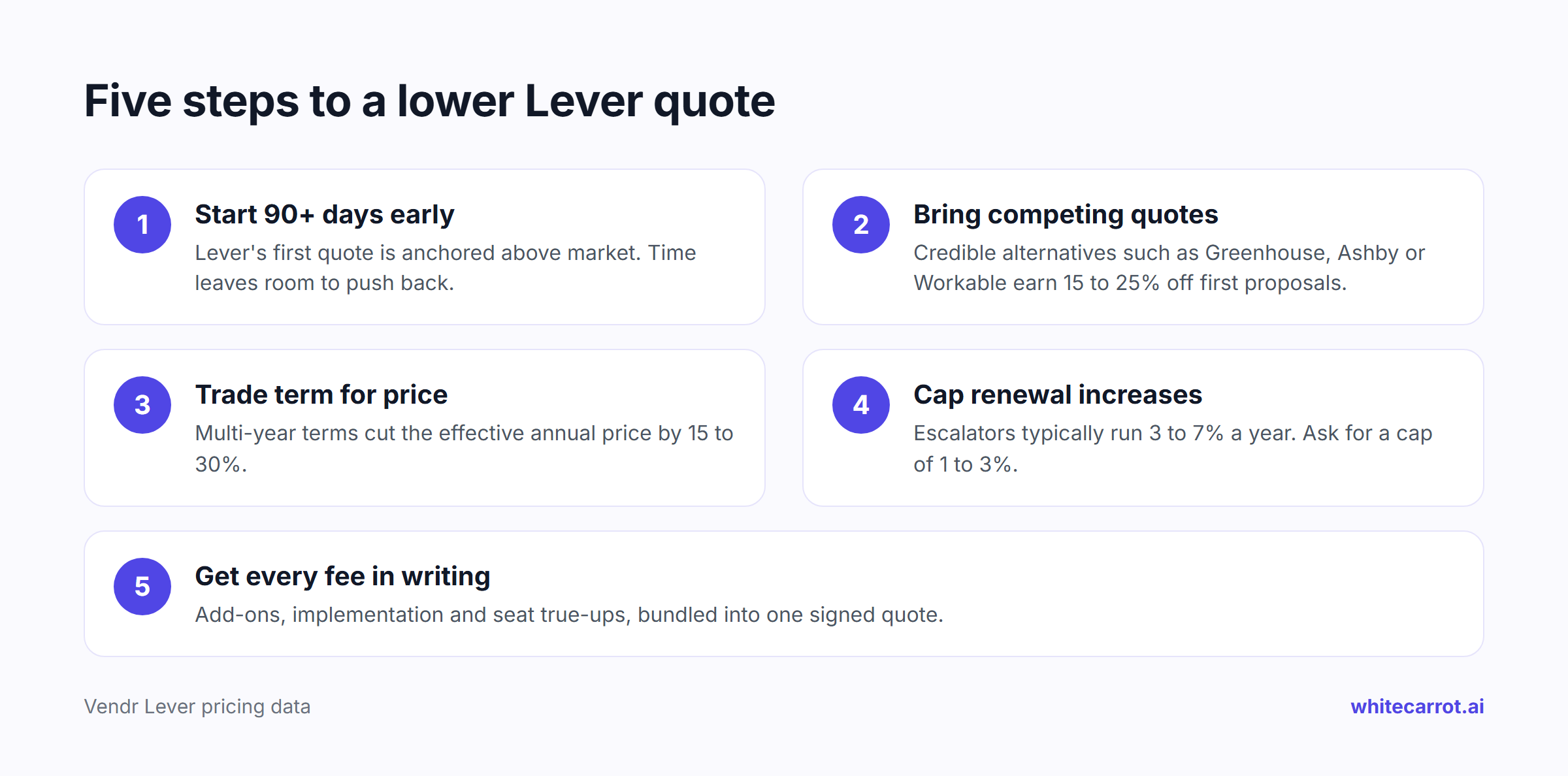
You can negotiate a lower Lever price by giving yourself time, bringing real alternatives and trading contract length for a lower annual rate. Vendr's Lever data says Lever's initial quotes are anchored above market, and recommends starting at least 90 days before the contract start or renewal date. Competitive evaluations against tools such as Greenhouse, Ashby or Workable earn 15% to 25% off the first proposal, and multi-year commitments lower the effective annual price by 15% to 30%. Vendr reports that combining these levers can take 25% to 40% off the initial quote. Bundling add-ons into the main contract saves 10% to 20%, and quarter-end or year-end timing adds another 5% to 15% of flexibility. At renewal, ask for a cap of 1% to 3% a year on multi-year terms, and negotiate seat flexibility or true-up terms so that headcount growth does not trigger mid-contract overage fees.
Start at least 90 days before your start or renewal date.
Bring dated quotes from two credible alternatives.
Trade a two- or three-year term for a lower annual rate.
Cap renewal increases in writing.
Get every add-on, implementation fee and true-up term into one signed quote.
The levers Vendr reports working most often on Lever deals.
Lever review: is Lever worth the price?
A fair Lever review starts with what Lever does well. Lever is a mature applicant tracking system with a recruiting CRM built in, and that pairing is its real strength: teams that source and nurture passive candidates do it in the same tool where they run interviews and offers. Lever's AI layer prioritises candidates, flags possible application fraud and writes unlimited interview transcripts and summaries, all in the core platform according to Lever's pricing page. Pin's review summary credits Lever with unlimited jobs and candidates, strong pipeline views and better collaboration than spreadsheets or basic tools. On the other side, the same summary reports that implementation often takes longer than sales estimates, that the enterprise tier adds cost for features buyers assumed were standard, and that headcount pricing penalises growing companies even when hiring volume stays flat.
Strengths: ATS and CRM in one record, unlimited jobs and candidates, AI transcripts included in the core platform, clear pipeline views.
Weaknesses: no public price, headcount-based billing, conversational screening and onboarding sold as add-ons, longer roll-outs than quoted.
Best fit: sourcing-heavy talent teams that run long nurture campaigns and have the budget for a mid-market ATS.
How does Lever pricing compare with Lever alternatives?
Lever alternatives are far easier to price, because most publish an entry price. Ashby lists its All-In-One Foundations plan at $400 a month for companies of up to 100 employees, with Plus and Enterprise on request. Workable shows Standard at $299, Premier at $599 and Enterprise at $719 a month for its 1 to 20 employee band, with a 15-day free trial. Manatal charges $15, $35 or $55 per user a month on annual billing, with a 14-day trial. The billing bases differ, so compare like for like: Ashby and Workable price by company size, Manatal by recruiter seat and Lever by total headcount. For a 200-person company with two recruiters, a seat-based tool will often cost a fraction of Lever's median, while a headcount-based tool will land closer to it. Our guide to AI alternatives to ATS software covers more options.
Tool
Published pricing
Billing basis
Lever
None; Vendr median $15,536 a year
Total company headcount; add-ons quoted separately
Ashby
Foundations $400 a month; Plus and Enterprise on request
Company size (Foundations up to 100 employees)
Workable
Standard $299, Premier $599, Enterprise $719 a month
Headcount band (prices shown for 1 to 20 employees)
AI recruiter platform, or Managed Hiring at one month's salary per placement
Lever vs Whitecarrot: which fits a GCC hiring team?
Lever vs Whitecarrot comes down to where your candidates come from and who does the first round. Lever suits teams that source and nurture talent over months. Whitecarrot is an AI recruiter for companies of 50 to 5,000 people in the UAE, Saudi Arabia and the wider GCC, where most roles draw hundreds of inbound applicants and two or three recruiters read every CV. Whitecarrot plans the requisition, posts to job boards and pulls every applicant into one place, then scores every CV and runs AI-assessed one-way video screening. It schedules interviews through Google or Outlook, joins as an AI notetaker, collects structured feedback and manages offers through e-signature before handing the hire to your HRMS.
More than 88 companies across the GCC hire with Whitecarrot, and across those customers time to hire has fallen from 45 days to under 20. Alabbar Enterprises in Dubai went from 8 recruiters making 350 hires a year to 3 recruiters making 850. Teams that want hiring done for them can use Managed Hiring: a shortlist within 24 hours, a placement fee of one month's salary and a 90-day replacement guarantee. Rent-a-Recruiter puts a recruiter on your roles within 48 hours with no retainer. If your Lever renewal is coming up and the bill is driven by headcount rather than hiring, it is worth pricing the switch. Book a Whitecarrot demo to see the AI recruiter on your own roles.
Frequently Asked Questions
Common questions about this topic answered below.
Does Lever have a free trial or free plan?
No. Lever's pricing page offers no free plan and no free trial; it offers a demo and a custom quote instead. Every Lever plan includes the core ATS, and pricing is tailored to company size and hiring needs. Teams that want to test an applicant tracking system first can try tools with published trials, such as Workable with 15 days or Manatal with 14 days.
How much does Lever cost per month?
Lever does not publish a monthly price; every contract is quoted and billed annually. Vendr's buyer data puts the median Lever contract at $15,536 a year, roughly $1,300 a month, with contracts from $6,720 to $51,540 a year. Because Lever prices on total company headcount, larger companies pay well above the median.
Who owns Lever?
Lever is owned by Employ, Inc., which sells it as Lever by Employ. Employ also owns the JazzHR and Jobvite applicant tracking systems, according to Pin's Lever pricing guide. Lever keeps its own product and pricing, and in May 2026 it added AI Screening by VONQ as a paid add-on.
Is Lever good for small companies?
Lever can work for small companies, but it is priced for mid-market teams that source heavily. With quote-only pricing, annual contracts and implementation fees on top, a company with under 100 employees and one recruiter often gets better value from a tool with published pricing, such as Ashby's $400-a-month Foundations plan or Workable's $299-a-month Standard plan.
Table of Content
Skip the hiring hassle
See how Whitecarrot helps you source, screen, and hire faster with AI.