Recruitment process outsourcing (RPO) is a hiring model in which an external provider runs all or part of a company's recruitment, from workforce planning and sourcing to screening, interviews and offers. The RPO team works as an extension of your HR team, under your employer brand, and is measured on time-to-fill and cost-per-hire rather than on single placements.
For UAE employers, RPO answers a specific problem: hiring volume that rises faster than the in-house team. TASC Outsourcing notes that people from over 200 nationalities live and work in the UAE, so a single role can draw candidates from a dozen markets. Add 2026 Emiratisation targets, and many HR teams need more recruiting capacity than they can justify as permanent headcount.
This guide is written for HR leaders, talent acquisition heads and founders. It covers how RPO recruitment works, the main models, what it costs, what it legally cannot do in the UAE, and when renting a recruiter or using an agency is the better choice.
What is recruitment process outsourcing (RPO)?
Recruitment process outsourcing is a contract under which a specialist provider takes over the recruitment function, or a defined piece of it, and runs it on the employer's behalf. Unlike a recruitment agency, which fills individual roles and sends candidates under its own name, an RPO provider operates as part of the employer's team. Recruiters may sit on the client's systems, email under the client's brand and report into the client's HR lead. The provider supplies the recruiters, sourcing tools, process and reporting, and the employer keeps the candidate data and the final hiring decision. According to Asanify's review of RPO companies in the UAE, RPO providers in the UAE cover role intake, sourcing, screening, structured interviews and shortlisting, measured on time-to-fill and quality of hire. RPO decides how a company hires. It does not change who legally employs the person: the hire still joins the employer's own UAE entity, visa and payroll.
How does RPO recruitment work?
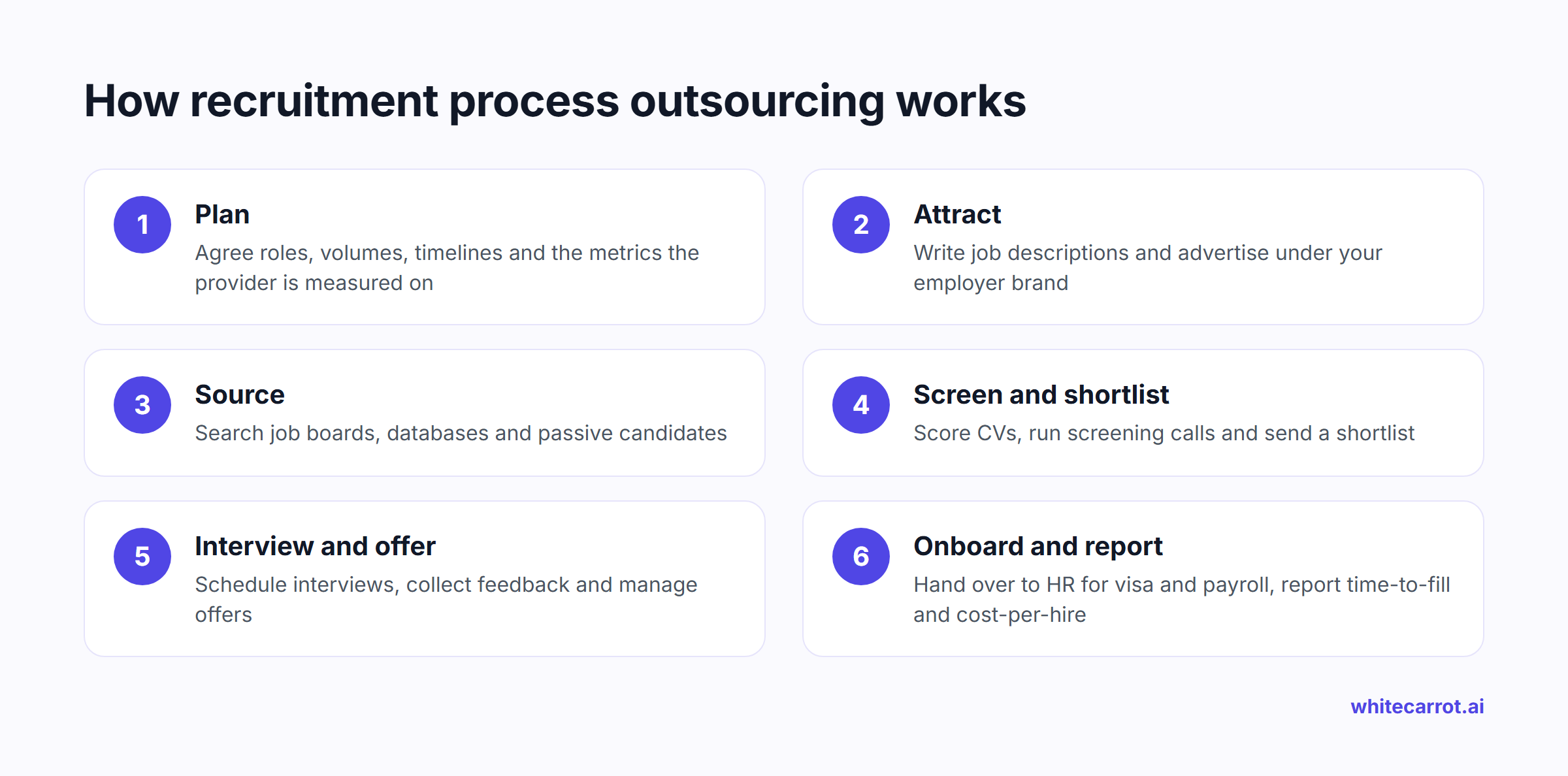
RPO recruitment works by moving defined hiring stages from the in-house team to the provider, under agreed service levels. A typical engagement starts with a discovery period in which the provider learns the roles, hiring managers, approval chain and existing tools. Both sides then agree volumes, timelines and the metrics the provider will be judged on, such as time-to-fill, offer acceptance rate and hiring-manager satisfaction. From there the RPO team runs the process day to day, and the employer's HR lead reviews progress weekly or monthly. The provider usually brings its own sourcing tools and an applicant tracking system, or works inside the employer's system so the data stays in one place. In the UAE, the handover at the end matters: once an offer is signed, the employer's HR or PRO team takes over the work permit, visa and payroll set-up.
Plan: agree roles, volumes, timelines and the metrics the provider is measured on.
Attract: write job descriptions and advertise under your employer brand.
Source: search job boards, databases and passive candidates.
Screen and shortlist: score CVs, run screening calls and send a shortlist.
Interview and offer: schedule interviews, collect feedback and manage offers.
Onboard and report: hand over to HR for visa and payroll, and report time-to-fill and cost-per-hire.
The six stages an RPO provider runs on the employer's behalf.
A clear brief speeds up every stage. If your role descriptions are out of date, draft new ones with a job description generator before the provider starts sourcing.
What are the types of RPO?
There are four common types of recruitment process outsourcing, and they differ by how much of the hiring cycle the provider runs and for how long. End-to-end RPO covers the whole cycle across the company, usually on a contract of a year or more. Project RPO covers the same full cycle for a fixed project, such as opening a new Dubai office or staffing a launch. Selective RPO, also called point-of-service RPO, hands over only the stages that are bottlenecks, such as sourcing or first-round screening. Recruiter on demand, often sold as rent a recruiter, adds dedicated recruiter capacity to your existing process for weeks or months. Most UAE companies start with project or selective RPO, because those models test the provider on a contained piece of work before a longer commitment.
RPO model
What the provider runs
Typical length
Best for
End-to-end RPO
The whole hiring cycle, from workforce plan to onboarding handover
A year or longer
Companies hiring steadily across many teams
Project RPO
The full cycle, but for one project, team or launch
A few months
New offices, market entries, seasonal peaks
Selective RPO
One or two stages, such as sourcing or screening
Ongoing or per stage
In-house teams with one bottleneck
Recruiter on demand (rent a recruiter)
Dedicated recruiter capacity working on your open roles
Weeks to months
A hiring spike without a long contract
How much does recruitment process outsourcing cost?
Recruitment process outsourcing cost depends on the pricing model, the hiring volume and the seniority of the roles. The RPO Association guide to pricing models describes three main structures: a management fee, a pay-for-performance model with a fee when each requisition opens and another when it closes, and a blend of both. A management fee gives predictable budgets but costs the same in a slow month. Pay-for-performance tracks hiring volume more closely but usually costs more in total. Published figures are mostly from the US market. Pin's 2026 RPO guide quotes management fees of USD 8,000–15,000 per recruiter per month, and cost-per-hire fees of 5–10% of annual salary. It compares those with 15–30% for contingency staffing agencies. Treat these as reference points, not UAE quotes, and ask every provider for a fee schedule in AED.
Pricing model
How you pay
Figures quoted
Watch out for
Management fee
A fixed monthly fee covering recruiters, technology and overhead
USD 8,000–15,000 per recruiter per month (Pin)
You pay the same in a slow month
Cost per hire
A fee for each completed hire, often a share of salary
5–10% of annual salary (Pin)
Provider effort can drop on hard roles
Hybrid
A lower monthly fee plus a fee per hire
USD 4,000–8,000 per recruiter, plus USD 1,000–3,000 per hire (Pin)
Two invoices to reconcile
Open/close fees
A fee when a requisition opens and another when it closes
Set per contract (RPO Association)
Higher total cost than a management fee
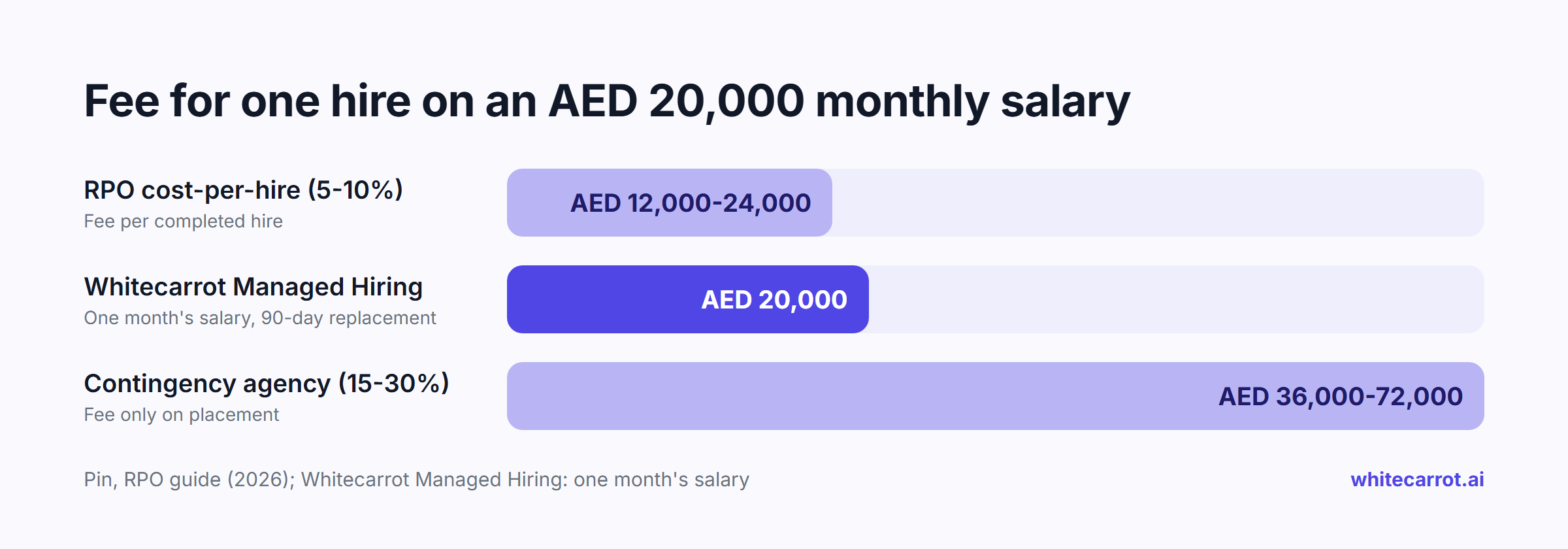
A worked example makes the difference concrete. Take a hire on an AED 20,000 monthly salary, or AED 240,000 a year. At Pin's cost-per-hire range of 5–10%, the RPO fee would be AED 12,000–24,000. At the 15–30% contingency agency range, the same hire would cost AED 36,000–72,000. A placement fee of one month's salary, as Whitecarrot Managed Hiring charges, would be AED 20,000.
Bars show the midpoint of each range. RPO and agency percentages from Pin's 2026 RPO guide, applied to AED 240,000 a year.
Fees are only part of the cost. Count the in-house time spent briefing, interviewing and approving, plus job-board spend and any assessment tools the contract excludes.
What is the difference between RPO and a recruitment agency?
The difference between RPO and a recruitment agency is ownership of the process. A recruitment agency fills specific roles it is briefed on, presents candidates under its own brand and is paid when a placement is made. An RPO provider runs your recruitment process, or part of it, as if it were your own team: it uses your brand, follows your interview stages, keeps the pipeline in your systems and is judged on process metrics across many hires. Agencies suit occasional or highly specialist roles, where paying a fee only on success makes sense. RPO suits companies with steady or rising hiring volume, where a per-placement fee on every role adds up and where building a talent pipeline is worth more than filling the next role. Many UAE companies use both: RPO for volume roles and an agency or executive search firm for senior hires.
An RPO provider in the UAE cannot legally employ your new hires, sponsor their visas or run their payroll. Asanify's review of RPO companies in the UAE makes the point directly: RPO providers do not sponsor employment visas, do not run Wage Protection System payroll and do not carry end-of-service or termination liability. Those obligations stay with the employer's UAE entity, or with an Employer of Record if you have no entity yet. In practice, that means your HR or PRO team must be ready to process work permits as soon as the RPO team closes offers. If visa processing takes longer than recruitment, time-to-start suffers no matter how fast the provider shortlists. Before signing, map exactly where the provider's work ends and your onboarding work begins, and put that handover in the service levels.
Emiratisation is the other UAE-specific issue. Private companies with 50 or more employees must raise the Emirati share of their skilled roles by 1% in each half of 2026, reported by Gulf Today. Missing the target brings a financial contribution of AED 10,000 per month for each Emirati not hired. Gulf News reported that companies with 20–49 employees in fast-growing sectors must hire at least one Emirati. An RPO provider can source and screen Emirati candidates, including through MoHRE's Nafis platform, but compliance remains the employer's responsibility.
Visas and work permits: stay with the employer or an Employer of Record.
WPS payroll: stays with the employer.
End-of-service and termination: stay with the employer.
Emiratisation targets: the provider can source candidates; the employer is accountable.
When does RPO make sense for a UAE company?
RPO makes sense for a UAE company when hiring volume is too high or too uneven for the in-house team, and paying agency fees on every role has become expensive. Common triggers are opening a new office or entity, a funding round with a hiring plan attached, a seasonal peak in hospitality or retail, or an Emiratisation target that needs a dedicated sourcing effort. RPO is usually the wrong choice when you hire only a handful of people a year, when roles are so senior that each one needs a confidential executive search, or when your process is still undefined. In that last case, an RPO provider will run a broken process faster. Fix the interview stages and approval chain first, then outsource.
Good fit: 50+ hires a year, several hiring managers, repeatable roles, a growth or expansion plan.
Weak fit: fewer than ten hires a year, mostly C-suite roles, no agreed interview process.
Middle ground: a short spike in hiring, which rent a recruiter often covers better than a full RPO contract.
What is rent a recruiter, and how is it different from RPO?
Rent a recruiter is a recruiter-on-demand service: you add one or more experienced recruiters to your team for a set period, and they work your open roles inside your process. Rent a recruiter differs from full recruitment process outsourcing in scope and commitment. A full RPO contract hands over the design and running of the process, with service levels, reporting and often a year-long term. Renting a recruiter adds capacity without changing who owns the process, and it can usually start faster and end sooner. It suits a company that has a working process but too many open roles, such as during a new-office build-out or a quarter with an unusual hiring plan. Because the recruiter works on your roles rather than on placements, the cost is tied to time, not to the number of hires.
How do you choose an RPO provider in the UAE?
Choose an RPO provider in the UAE on its recent results in your sector, the recruiters who will actually do the work, the technology it brings, and the clarity of its pricing and handover. Large global firms and regional specialists both operate in the market, so size matters less than fit. Ask each provider to show the time-to-fill and offer acceptance figures it achieved for a client of your size, and to name the recruiters assigned to your account. Insist that candidate data lives in a system you own or can export from. Finally, compare pricing on the same hiring plan, in AED, so management fees and per-hire fees can be added up side by side.
Ask for sector proof: recent GCC clients of your size and the metrics achieved.
Name the team: the recruiters and account lead, with their time commitment.
Check the technology: applicant tracking, screening and scheduling tools, and who owns the data.
Get AED pricing on your plan: management fee, per-hire fees and exclusions.
Define the handover: where the provider stops and your visa and onboarding work starts.
Set exit terms: notice period, data export and what happens to open roles.
How Whitecarrot supports recruitment process outsourcing in the UAE
Whitecarrot is a Dubai-based hiring company working with 88+ companies across the GCC, and it offers three ways to outsource recruitment depending on how much control you want to keep. Whitecarrot Rent-a-Recruiter puts a recruiter on your roles within 48 hours, with no retainer. Whitecarrot Managed Hiring runs hiring for you: a shortlist within 24 hours, a placement fee of one month's salary and a 90-day replacement guarantee. For senior roles, executive search runs a confidential leadership search.
If you would rather keep recruitment in-house, the Whitecarrot AI Recruiter scores CVs, runs AI-assessed one-way video screening and schedules interviews in Google or Outlook. Whitecarrot customers have cut time-to-hire from 45 days to under 20.
RPO stands for recruitment process outsourcing. It means an external provider runs all or part of a company's recruitment, such as sourcing, screening, interview scheduling and offers, as an extension of the in-house HR team. The provider works under the employer's brand and is measured on process metrics like time-to-fill and cost-per-hire, rather than being paid per placement like an agency.
How much does RPO cost in the UAE?
RPO cost in the UAE depends on the pricing model and volume. Providers charge a monthly management fee, a fee per hire, or both. US benchmarks quoted by Pin are USD 8,000–15,000 per recruiter per month, or 5–10% of annual salary per hire. Ask UAE providers for an AED fee schedule built on your own hiring plan before comparing them.
What is the difference between RPO and a recruitment agency?
An RPO provider runs your recruitment process as part of your team, under your brand, across many hires. A recruitment agency fills individual roles under its own brand and is paid a fee when a candidate is placed. RPO suits steady or growing hiring volume; an agency suits occasional or specialist roles where paying only on success makes more sense.
Can an RPO provider sponsor UAE work visas?
No. An RPO provider in the UAE does not sponsor employment visas, run Wage Protection System payroll or carry end-of-service liability. Those stay with the employer's UAE entity, or with an Employer of Record if the company has no entity. The RPO provider finds and hires the candidate; your HR or PRO team then handles the work permit and visa.
Table of Content
Skip the hiring hassle
See how Whitecarrot helps you source, screen, and hire faster with AI.