The main application tracking system software alternatives in 2026 are Workable, Greenhouse, Zoho Recruit, Manatal and BambooHR, plus AI recruiter platforms such as Whitecarrot that do the screening work themselves. Prices run from free plans to custom enterprise quotes, and most vendors charge per recruiter seat or by company headcount.
This guide explains what application tracking system software does, compares the leading options on pricing and features, and shows how to choose one as an employer in the UAE, Saudi Arabia or the wider GCC. Every price below was checked on the vendor's own pricing page in October 2026. Where a vendor does not publish prices, we say so instead of guessing.
What is application tracking system software?
Application tracking system software is a hiring tool that collects job applications in one place, stores candidate records, and moves each applicant through stages such as screening, interview and offer. The industry name is "applicant tracking system" (ATS); "application tracking system" is a common variant of the same term, and both describe the same product. Application tracking system software replaces the shared inbox and spreadsheet that most teams start with. It posts jobs to career sites and job boards, parses CVs into searchable profiles, schedules interviews and keeps feedback from every interviewer on the candidate record. Large employers rely on it almost without exception: according to Jobscan's 2026 Fortune 500 ATS report, 97.4% of Fortune 500 companies use a detectable ATS, with Workday alone used by over 40% of them. Mid-sized GCC companies are now following, mostly to cut screening time and to give hiring managers one view of every role.
What are the best application tracking system software alternatives in 2026?
The best application tracking system software for a GCC employer depends on how many roles you hire for, who does the screening, and whether you already run an HR suite. Workable suits mid-sized teams that want a polished all-rounder. Greenhouse fits companies with structured, multi-stage interview processes. Zoho Recruit and Manatal are the lower-cost options with per-recruiter pricing. BambooHR makes sense when you want hiring inside a broader HR system. AI recruiter platforms such as Whitecarrot are the alternative for teams that want the software to screen and schedule, not just track. The table compares application tracking system software alternatives on published pricing and best fit. If you are mainly weighing AI-first tools, our guide to AI alternatives for ATS software goes deeper on that group.
Tool
Published pricing (Oct 2026)
Pricing basis
Best for
Workable
Standard from $299/month; Premier and Enterprise on annual billing
Company headcount tier
Mid-sized teams wanting an all-rounder
Greenhouse
Not public (Core, Plus, Pro quoted)
Custom by hiring volume
Structured interviews at scale
Zoho Recruit
Free plan (1 active job per recruiter); paid plans via calculator
Workable is a full ATS with sourcing, a careers page, video interviews and an AI agent. According to Workable's pricing page, the Standard plan costs $299 a month or $3,588 a year, with Premier and Enterprise plans above it. Prices are set by company headcount band, so confirm your tier. Texting, video interviews and assessments are paid add-ons on Standard, and the Workable Agent runs on AI credits bought in packs. There is a 15-day free trial with no card.
Greenhouse
Greenhouse is known for structured hiring: interview kits, scorecards and reporting that keep large panels consistent. Greenhouse's pricing page lists Core, Plus and Pro plans but no prices; cost is customised by hiring volume and features, and you request a demo for a quote. It suits companies with many interviewers per role and a recruiting operations function to run it.
Zoho Recruit
Zoho Recruit is the low-cost entry point. Its Forever Free plan includes candidate management, email and interview scheduling for one active job per recruiter licence. Paid Standard and Enterprise plans are billed per recruiter licence, monthly or yearly, and add AI candidate matching, automation and analytics. The pricing page gives exact amounts through a calculator rather than a list price.
Manatal
Manatal is one of the few vendors with a clear price list. Manatal's pricing page shows Professional at $15, Enterprise at $35 and Enterprise Plus at $55 per user a month on annual billing, or $19, $39 and $59 billed monthly. Professional caps you at 15 jobs, so growing teams usually need Enterprise. A 14-day trial needs no card.
BambooHR
BambooHR is an HR suite with an applicant tracking system built in. BambooHR's pricing page shows a flat $250 a month on Core for 25 or fewer employees, then about $10 per employee a month, with Pro and Elite above it. The ATS is included in every plan, but the number of open jobs rises with the tier. It is a good fit if you want records and hiring in one place, and less so for high-volume hiring. We cover broader HR suites in our HCM software alternatives guide.
How much does application tracking system software cost?
Application tracking system software pricing ranges from free plans to custom annual contracts, and the pricing model matters as much as the headline number. A per-recruiter tool such as Manatal costs $75 a month for five users on its entry plan at annual rates, while a headcount-priced tool charges the same whether two people or ten use it. Enterprise vendors such as Greenhouse do not publish prices at all. Before comparing quotes, work out which model fits how your team hires. The common application tracking system software pricing models are:
Per user or per recruiter: you pay for each seat that screens candidates (Manatal, Zoho Recruit). Cheap for small teams, expensive if every hiring manager needs a seat.
By company headcount: one price for your employee band, unlimited users (Workable). Predictable, but you pay for growth even in a hiring freeze.
Per employee inside an HR suite: hiring is one module of a wider system (BambooHR). Good value if you need the rest of the suite.
Custom quote: priced on volume, modules and support (Greenhouse). Expect a sales process and an annual contract.
Add-ons and credits: video interviews, texting, assessments and AI actions are often billed separately, so total cost can run well above the plan price.
Ask every vendor for the full first-year cost, including setup, job-board and integration fees, and the renewal terms.
What features should application tracking system software have?
Application tracking system software features fall into two groups: the core tracking that every ATS has, and the automation that separates a modern tool from a digital filing cabinet. Core features are job posting, a careers page, CV parsing, a candidate database, pipeline stages, interview scheduling and reporting. The features that actually save recruiter time are automatic CV scoring, screening interviews that run without a recruiter, calendar-linked scheduling and structured feedback. GCC employers should add three checks that global "best ATS" lists usually skip: Arabic and right-to-left support, posting to regional job boards, and candidate messaging on channels people in the region actually answer, such as WhatsApp.
Feature
Why it matters
What to ask the vendor
Multi-board job posting
Reach without re-typing every ad
Which GCC boards are connected?
CV parsing and scoring
Hundreds of applicants per role need ranking
Does it score against the job, or only parse?
Screening interviews
First-round calls take most recruiter hours
Is one-way video included or an add-on?
Interview scheduling
Back-and-forth email slows every stage
Does it sync with Google and Outlook?
Structured feedback
Fairer, faster decisions
Can managers submit scorecards on mobile?
Offers and onboarding
No re-keying into the HR system
Is there e-signature and an HRMS sync?
Data protection
CVs are personal data
How do you support UAE PDPL consent and deletion?
On data protection, UAE employers process candidate CVs under the Personal Data Protection Law, Federal Decree-Law No. 45 of 2021, which generally requires consent, security controls and the right to correct or stop processing. Your ATS should make those requests easy to honour.
What are the benefits of application tracking system software?
The benefits of application tracking system software come from replacing manual handling with one shared record per candidate. Teams that move off email and spreadsheets typically gain in five areas:
Speed: automated posting, screening and scheduling remove the waits between stages, which is where most time-to-hire is lost.
Visibility: hiring managers see every candidate and stage without asking a recruiter for an update.
Consistency: the same stages, questions and scorecards for every role make decisions easier to compare and defend.
Candidate experience: applicants get confirmations, interview slots and decisions without being forgotten in an inbox.
Reporting: source, stage and time-to-fill data show which job boards and steps work.
The size of the gain depends on how much of the work the software does. Alabbar Enterprises in Dubai went from 8 recruiters making 350 hires a year to 3 recruiters making 850 after moving hiring onto Whitecarrot, and its time-to-hire fell from 44 days to as low as 2.
Which application tracking system software is best for recruiters?
Application tracking system software for recruiters should be judged on one thing first: whether it removes their most repetitive work. The best option is the one that takes over reading CVs and running first-round calls. An in-house recruiter handling ten or more open roles needs ranked shortlists, bulk messaging and self-service scheduling more than a polished careers page. Agency recruiters need a strong candidate database and client-facing pipelines; Zoho Recruit, for example, offers candidate and staffing portals on its Enterprise plan. Recruiters supporting many hiring managers should check how easy it is for managers to leave feedback, because chasing scorecards is a hidden time cost. If CV volume is your bottleneck, our guide to AI resume screening explains how scoring works and where it needs human review.
Application tracking system software vs a hiring agent: what is the difference?
Application tracking system software records and organises the hiring process, while a hiring agent does parts of the process itself. A traditional ATS waits for a recruiter to read each CV, call each candidate and book each interview; it then stores the result. An AI hiring agent reads and scores the CVs, runs the screening interview, and books the next round, leaving people to make the decisions. The two are not exclusive: many teams keep their ATS as the system of record and add an agent on top. For a fuller definition, see what is a hiring agent.
Task
Application tracking system software
AI hiring agent
CV review
Parses and stores; recruiter reads
Scores every CV against the role
First-round screening
Recruiter phone calls
Runs and assesses screening interviews
Scheduling
Self-booking links, often an add-on
Books interviews in Google or Outlook
Decisions
People
People, with ranked evidence
How should you read an application tracking system software review?
An application tracking system software review is only useful if the reviewer hires like you do. Most review sites and "best ATS" lists are dominated by US and European buyers, and several are written by vendors that rank themselves first. When you read an application tracking system software review, check the reviewer's company size, their hiring volume, the countries they hire in and the date of the review, because ATS products change every quarter. Then ignore star ratings and run a trial on one live role with your own job boards, interviewers and candidates. A week of real use shows more than any score.
How do you choose the right application tracking system software?
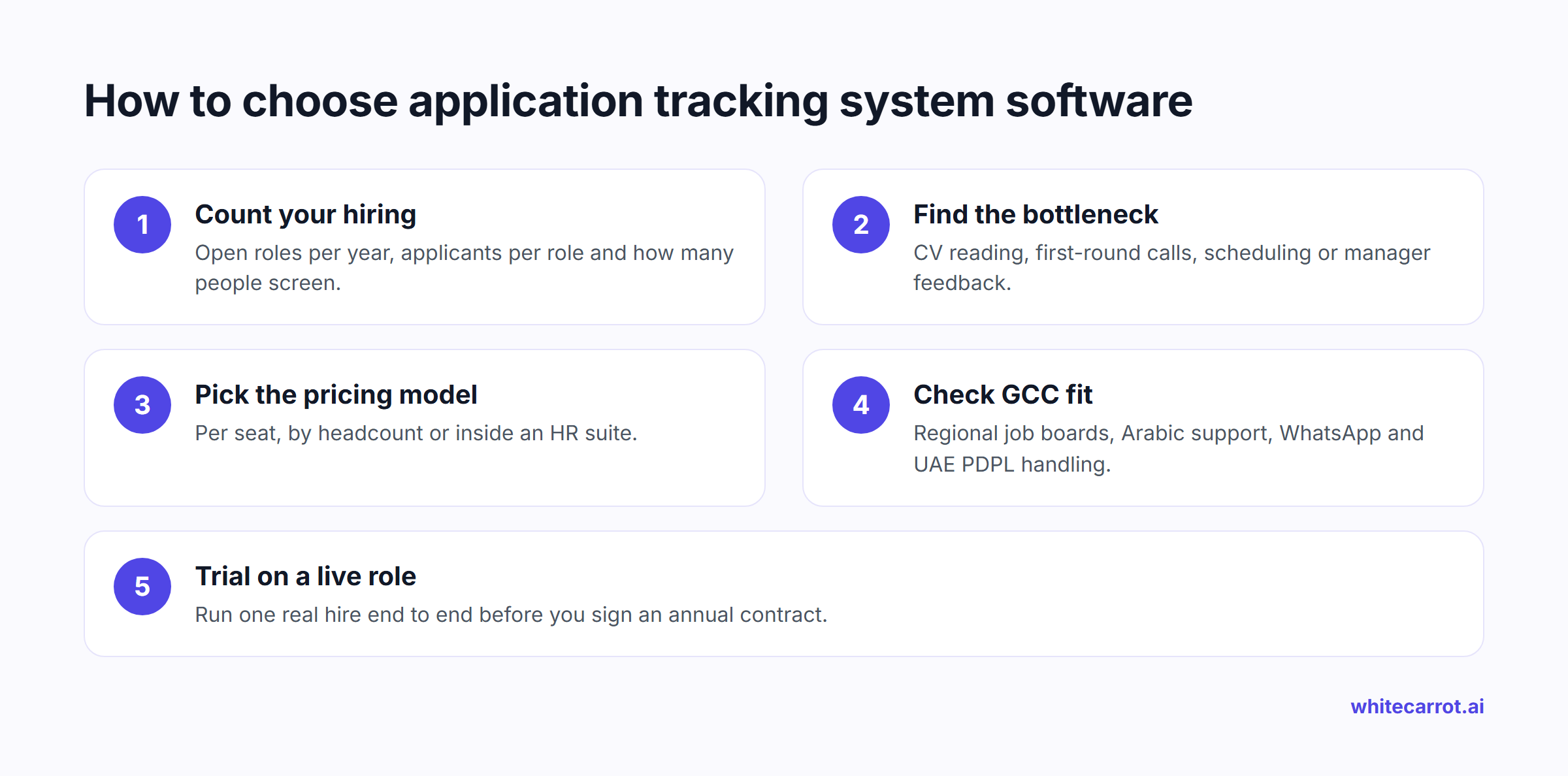
Choosing application tracking system software is easier if you start from your hiring volume and bottleneck, not from vendor demos. Five steps keep the decision grounded:
Count your hiring: open roles per year, applicants per role and how many people screen.
Find the bottleneck: CV reading, first-round calls, scheduling or manager feedback.
Pick the pricing model: per seat, by headcount or inside an HR suite, based on step one.
Check GCC fit: regional job boards, Arabic support, WhatsApp and UAE PDPL handling.
Trial on a live role: run one real hire end to end before you sign an annual contract.
Start from your hiring volume and bottleneck, not from vendor demos.
Where does Whitecarrot fit among application tracking system software alternatives?
Whitecarrot is an AI recruiter platform that tracks applicants like any ATS and also does the screening and coordination work an ATS leaves to people. It plans the requisition, posts to job boards, scores every CV against the role, runs AI-assessed one-way video screening, schedules interviews in Google or Outlook, joins as an AI notetaker, collects structured feedback and manages offers through e-signature and HRMS onboarding. More than 88 companies across the GCC hire this way, and companies using it have cut time-to-hire from 45 days to under 20.
Beehive, a UAE fintech, ran HR on BambooHR but hiring was still manual, with CVs arriving through email, LinkedIn and Teams and no single view. After moving to Whitecarrot, its hiring managers fill junior roles themselves without assigning a recruiter. Read how it works for HR and TA leaders, or book a Whitecarrot demo and see it run on one of your live roles.
Frequently Asked Questions
Common questions about this topic answered below.
Is an application tracking system the same as an applicant tracking system?
Yes. Application tracking system and applicant tracking system describe the same software. Applicant tracking system (ATS) is the industry term, and application tracking system is a common variant used in search. Both collect job applications, store candidate records and move applicants through screening, interviews and offers, so you can compare products under either name.
How much does application tracking system software cost?
Application tracking system software costs anything from nothing to a custom annual contract. Zoho Recruit has a free plan, Manatal charges $15 to $55 per user a month on annual billing, Workable's Standard plan is $299 a month, and Greenhouse quotes privately. Add-ons such as video interviews and AI credits can raise the total, so ask for a full first-year price.
Is there free application tracking system software?
Yes. Zoho Recruit offers a Forever Free plan with candidate management, email and interview scheduling for one active job per recruiter licence. Most other vendors offer free trials instead, such as Workable's 15 days and Manatal's 14 days. A free plan suits a team hiring for one or two roles; growing teams usually outgrow the job limits quickly.
Do small businesses need application tracking system software?
A small business needs application tracking system software once applications arrive faster than one person can read them, often at a few open roles at a time. Before that, a shared inbox works. Small teams usually start with per-user tools such as Manatal or Zoho Recruit, or an HR suite like BambooHR that includes an ATS on every plan.
Table of Content
Skip the hiring hassle
See how Whitecarrot helps you source, screen, and hire faster with AI.