Eightfold AI pricing is not published. Eightfold sells by demo and custom quote, with no price list, free plan or self-serve trial on its website. According to OutSail’s 2026 Eightfold review, the full platform costs about $7 to $10 per employee per month on annual contracts. For a 1,000-person company, that is roughly $84,000 to $120,000 a year before implementation.
Those numbers surprise many HR teams, because Eightfold bills on total company headcount rather than recruiter seats. This guide explains what Eightfold AI costs in 2026, how the pricing model works, and what it adds up to at different company sizes. It covers the costs outside the licence, how to negotiate a quote, and a fair Eightfold AI review. It ends with Eightfold AI alternatives at published prices and an honest Eightfold AI vs Whitecarrot comparison for employers in the UAE, Saudi Arabia, Singapore and Hong Kong.
How much does Eightfold AI cost in 2026?
Eightfold AI costs about $7 to $10 per employee per month for the full talent intelligence platform, according to OutSail. That estimate comes from a third party, because Eightfold itself shows no prices. Fast.io’s 2026 Eightfold review reports contracts of $150,000 to $300,000 a year for mid-market companies with 2,000 to 5,000 employees. The same review puts large enterprises with more than 10,000 employees at $500,000 to $1.2 million a year. One real contract is public: Pin’s Eightfold pricing guide cites a U.S. Air Force award of $329,925.63 for one year, made in September 2025 and recorded on USAspending. Eightfold’s newer AI Interviewer is priced separately. Eightfold’s own pricing note says it scales with interview volume and use case, and describes a five-figure investment for mid-size organisations. Treat every figure here as a benchmark to test a quote against, not as a list price.
Eightfold AI pricing works on a per-employee, per-month basis, charged on your whole workforce and paid through an annual enterprise contract. Pin notes that a company pays for every employee in scope, not for the handful of recruiters who log in, and that there is no self-serve tier, free plan or free trial. Eightfold sells the platform in modules, which its website groups into three families. Talent Intelligence covers Talent Acquisition, Talent Management, Workforce Exchange and Resource Management. Talent Agents include the AI Interviewer, AI Interview Companion, AI Candidate Concierge and AI Recruiting Teammate. TalentForge is a layer for building custom talent apps and agents. Because each module is quoted, two companies of the same size can pay very different amounts. Eightfold’s pricing note adds that per-employee figures seen online apply to the full platform, not to the AI Interviewer alone.
Billing basis: total employee headcount, per month, billed annually.
Contract: annual enterprise agreement; no free plan or trial.
AI agents: AI Interviewer priced by interview volume and use case.
Extras: implementation, integration and training on top of the licence.
What would Eightfold AI cost for a company of your size?
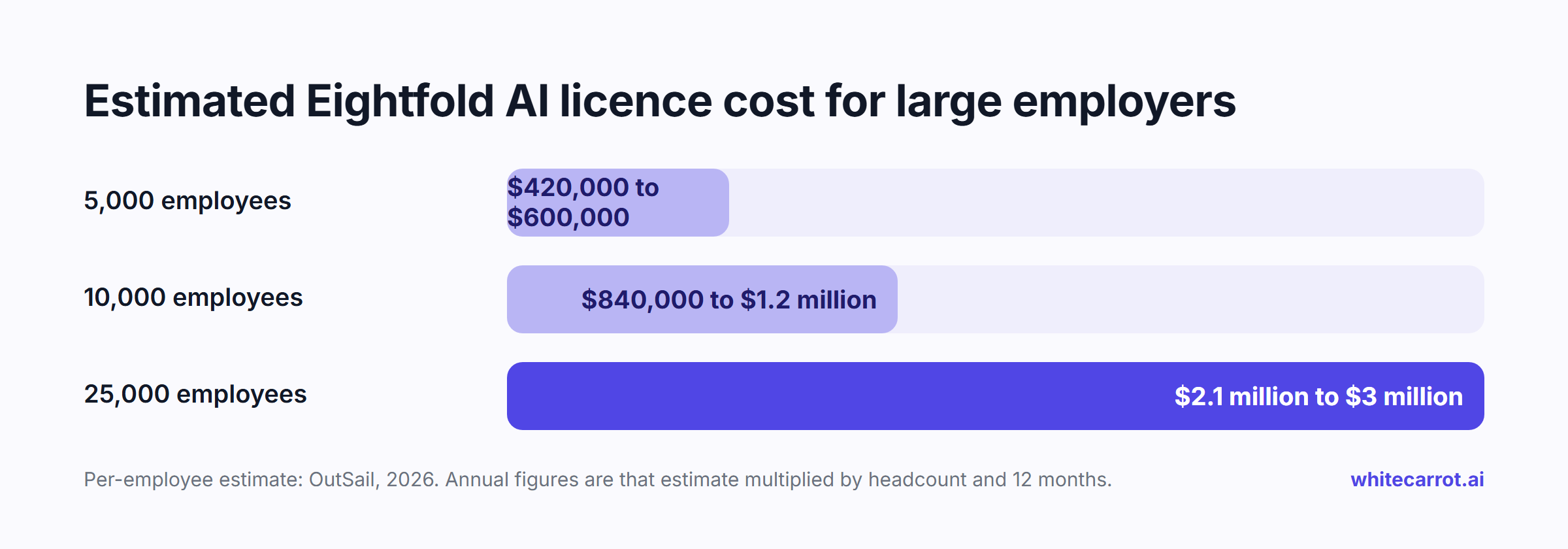
The cost of Eightfold AI for a given company is its headcount multiplied by $7 to $10 a month, multiplied by 12. Using OutSail’s estimate, TestGorilla’s Eightfold review works out $84,000 to $120,000 a year for 1,000 employees and $840,000 to $1.2 million for 10,000 employees. TestGorilla adds that it could not confirm the estimate, and that the figure covers the licence only. The same arithmetic gives $42,000 to $60,000 a year for a 500-person company. That matters in the GCC, where many growing employers have 200 to 2,000 staff and only two or three recruiters. Such a company would pay for every employee in the business, even though only the talent team uses the product. Eightfold itself has said the platform is best used by companies of 10,000 employees or more, according to TestGorilla, while its AI Interviewer targets organisations of 1,000 to 5,000 people. Mid-size buyers should therefore ask whether a single module meets the need before pricing the whole platform.
Annual licence only, at the $7 to $10 per employee per month estimate. Implementation, training and add-ons are extra.
What hidden costs come with Eightfold AI?
The hidden costs of Eightfold AI sit mostly in implementation, integration and the time it takes a team to trust the scores. Fast.io puts implementation at $5,000 to $50,000 over 4 to 12 weeks. OutSail says integration, training and implementation are charged separately and vary with the organisation’s size and complexity. OutSail also reports that some users find integration with an existing ATS and HR systems difficult, which can add delays and cost. Pin builds a year-one example for a 5,000-person company of $455,000 to $745,000, once implementation, training and lost recruiter time during ramp-up are added to the licence. Pin is a competing sourcing tool, so read its examples as one estimate. Still, the pattern is consistent across sources: the first-year cost of Eightfold AI is meaningfully higher than the licence quote alone.
Implementation: $5,000 to $50,000 and 4 to 12 weeks, per Fast.io.
Integration: connecting Workday, SAP SuccessFactors or another ATS, which reviewers describe as hard.
Training: OutSail reports an interface that can need extra user training.
AI agents: the AI Interviewer and other agents are priced on their own.
Renewals: per-employee billing rises as your workforce grows, even if hiring volume does not.
How can you negotiate an Eightfold AI quote?
You can negotiate an Eightfold AI quote by narrowing what counts toward the price and by fixing future costs in the contract. Pin’s Eightfold pricing guide recommends asking for module-only pricing, a renewal cap of 3% to 5%, credits against implementation fees, a performance-based exit clause and a paid pilot. Each lever targets a specific risk of per-employee billing. Agreeing which employees are in scope, for example only the business units that hire through Eightfold, can cut the base number. Module-only pricing stops you paying for internal mobility or workforce planning you will not use in year one. A renewal cap protects you as headcount grows. Ask for the full first-year cost in writing, including every module, implementation, training and the renewal terms, before you compare Eightfold AI with any alternative.
Set the headcount: agree which employees count toward the per-employee price.
Buy only the modules you need: ask for module-level pricing instead of the full platform.
Get implementation in writing: ask for fee credits and a fixed rollout timeline.
Cap renewals: ask for a renewal cap of 3% to 5% a year.
Start with a paid pilot: add a performance-based exit clause before a long commitment.
Use these steps before you sign an Eightfold AI contract.
Eightfold AI review: is it worth the cost?
Eightfold AI is worth the cost for very large employers that want one skills layer across hiring, internal mobility and workforce planning. According to Eightfold’s website, the platform draws on 1.6 billion career trajectories and 1.6 million skills, and customers include Salesforce, Citi, HSBC and Deutsche Telekom. It holds SOC 2 Type II and ISO/IEC 42001 certification and FedRAMP Moderate authorisation. TestGorilla lists Eightfold at 4.2 out of 5 on G2, 4.0 on Capterra and 7.6 out of 10 on TrustRadius as of September 2026. Fast.io reports that reviewers like the match scores, the internal mobility tools and candidate masking during screening. The same review lists slow customer support, a learning curve before match scores feel reliable, limited analytics and ATS integrations that can break during upgrades. It also notes that Eightfold ranks candidates already in your pipeline rather than sourcing passive ones.
Two governance points belong in any Eightfold AI review. First, Fast.io reports that an early-2026 audit by BABL AI under New York City Local Law 144, covering more than 29 million assessments, found Eightfold passed on disparate impact, governance and risk assessment. Second, a class action filed in January 2026 alleges that Eightfold’s match scores work like consumer reports under the U.S. Fair Credit Reporting Act; Pin reported no ruling on the motion to dismiss as of September 2026. The suit does not claim the algorithm is biased, but legal and procurement teams will want to read it before signing.
What are the best Eightfold AI alternatives by price?
The best Eightfold AI alternatives by price are the tools that publish what they charge, so you can budget before a sales call. SeekOut lists Sourcing Core at $149 a month billed annually, with three seats and a 14-day trial. hireEZ starts solo recruiters at $494 a month with a 7-day trial. Workable shows Standard at $299, Premier at $599 and Enterprise at $719 a month for its smallest company band, with a 15-day trial. Phenom and Beamery, the closest enterprise rivals, do not publish prices; Fast.io cites about $10,000 a month for Phenom and about $220,000 a year on average for Beamery. Whitecarrot lists its Recruiter Pro plan on its pricing page at $1,000 per user a month with a two-seat minimum. For a wider list, see our guide to AI recruitment software alternatives.
Tool
Published pricing
Pricing basis
Best for
Eightfold AI
Not public; estimated $7 to $10 per employee a month
Total headcount
Enterprises of 10,000+ wanting talent intelligence
SeekOut
Sourcing Core $149 a month billed annually; other plans custom
Seats (3 included)
Sourcing passive candidates
hireEZ
Solo recruiters from $494 a month; enterprise custom
Configured to the stack it replaces
Sourcing and CRM on top of an ATS
Workable
$299, $599 or $719 a month (1 to 20 employee band)
Plan and company size
An all-round ATS at a visible price
Phenom
Not public; about $10,000 a month per Fast.io
Quote
Enterprise career sites and talent CRM
Beamery
Not public; about $220,000 a year average per Fast.io
Quote
Enterprise skills and workforce planning
Whitecarrot
Recruiter Pro $1,000 per user a month (2-seat minimum); Teams on request
Recruiter seats
GCC teams that want an AI recruiter or done-for-you hiring
Eightfold AI vs Whitecarrot: which fits a GCC hiring team?
Eightfold AI vs Whitecarrot comes down to company size and to the problem you are paying to solve. Eightfold is the stronger choice for a global employer of 10,000 or more people that wants skills matching across hiring, internal mobility and workforce planning, and has the budget and IT team to implement it. Whitecarrot is built for HR and talent teams of growing companies in the GCC that need hires made faster with a small team. Its AI recruiter plans the requisition, posts to job boards, scores CVs, runs AI-assessed one-way video screening, schedules interviews in Google or Outlook, joins as an AI notetaker, and manages offers through e-signature. Pricing follows recruiter seats, not total headcount, so a 1,000-person company with two recruiters pays for two seats. More than 88 companies across the GCC use Whitecarrot, and customers have cut time-to-hire from 45 days to under 20. Teams that would rather not run hiring themselves can use Managed Hiring: a shortlist within 24 hours, a placement fee of one month’s salary and a 90-day replacement guarantee.
Eightfold AI
Whitecarrot
Pricing
Not public; estimated $7 to $10 per employee a month
Published: Recruiter Pro $1,000 per user a month
Billing basis
Total company headcount
Recruiter seats
Best fit
Enterprises of 10,000+ employees
Growing GCC companies with small talent teams
Core strength
Skills intelligence and internal mobility
AI recruiter that screens, schedules, takes notes and manages offers
Done-for-you option
No
Managed Hiring and Rent-a-Recruiter
Rollout
4 to 12 weeks, per Fast.io
Works with Google or Outlook calendars and job boards
If your team is weighing an enterprise talent suite against the hiring work it actually needs done, see how AI shortlisting handles CV volume, then book a Whitecarrot demo to price it on your own recruiter count.
Frequently Asked Questions
Common questions about this topic answered below.
Does Eightfold AI have a free trial?
No. Eightfold AI offers no free trial, free plan or self-serve tier; its website offers a demo and a custom quote instead. Contracts are annual enterprise agreements. Buyers who want to test before committing can ask Eightfold for a paid pilot with a performance-based exit clause, or trial an alternative such as SeekOut, hireEZ or Workable, which publish trial periods.
How much does Eightfold AI cost per employee?
Eightfold AI costs an estimated $7 to $10 per employee per month for the full platform, according to OutSail. Eightfold does not publish this figure, and TestGorilla notes it could not confirm it. The price is charged on total company headcount, so a 1,000-person company would pay about $84,000 to $120,000 a year before implementation.
What size company is Eightfold AI built for?
Eightfold AI is built mainly for large enterprises. TestGorilla reports that Eightfold described the platform as best used by companies of 10,000 employees or more. Its AI Interviewer is aimed lower, at organisations of 1,000 to 5,000 employees, according to Eightfold's own pricing note. Smaller teams usually get better value from seat-priced tools.
Is Eightfold AI facing a lawsuit?
Yes. A class action filed in January 2026 alleges that Eightfold AI's match scores act as consumer reports under the U.S. Fair Credit Reporting Act. The suit does not claim the algorithm is biased. Pin reported no ruling on the motion to dismiss as of September 2026, and an independent 2026 bias audit found Eightfold passed under NYC Local Law 144.
Table of Content
Skip the hiring hassle
See how Whitecarrot helps you source, screen, and hire faster with AI.