Workable vs Whitecarrot comes down to who does the screening. Workable is an applicant tracking system with light HR and AI agents that are paid for in credits. Whitecarrot is an AI recruiter built for hiring in the GCC: it scores CVs, screens candidates on video and books interviews, and it can also deliver the shortlist for you.
Both are solid products for different buyers. This comparison of Workable vs Whitecarrot covers what each one does at every hiring stage, what Workable costs by company size, what reviewers say, how each fits an employer in the UAE or Saudi Arabia, and when to pick which. Prices come from Workable's own pricing page and a dated third-party guide, both checked in November 2026.
Workable vs Whitecarrot: what is the difference?
The difference between Workable and Whitecarrot is where the work sits. Workable gives a recruiting team a clean place to post jobs, track candidates and collaborate with hiring managers, and it adds an HR module for employee records, time off and onboarding. Its AI agent can source, score and message candidates, but each action uses AI credits on top of the plan. Whitecarrot is built to take the manual hours out of hiring: the Whitecarrot AI recruiter plans the requisition, posts the role, scores every CV, runs AI-assessed one-way video screening, schedules interviews and sends offers for e-signature. It does not run HR records or payroll; it hands each hire to the HRMS you already use. Whitecarrot also sells Managed Hiring, where its team delivers a shortlist within 24 hours. In short, Workable is a tool your recruiters operate, while Whitecarrot does much of the screening work for them.
What is Workable and who is it built for?
Workable is a recruiting and HR platform used mainly by small and mid-sized companies. According to Workable’s job distribution page, it posts a job to more than 200 job boards across over 100 countries, and it is an Indeed and LinkedIn partner. Every plan includes a sourcing suite, the applicant tracking system, unlimited active jobs under a fair-use policy, a hiring plan and a custom report builder. Every plan also includes an HR information system, onboarding, time off and time tracking, and payroll preparation, though not payroll itself.
OutSail’s November 2024 Workable review places it with mid-market companies that have straightforward hiring needs and want strong sourcing, including a LinkedIn Recruiter integration. It says Workable is less suited to complex hiring processes.
What is Whitecarrot and who is it built for?
Whitecarrot is an AI recruiter for companies of 50 to 5,000 people in the UAE, Saudi Arabia and the wider GCC, and more than 88 companies in the region hire with it. Whitecarrot covers hiring from end to end: it plans the requisition, posts to job boards and pulls every applicant into one place, scores CVs, screens candidates on AI-assessed one-way video, schedules interviews through Google or Outlook, joins interviews as an AI notetaker, collects structured feedback and manages offers through e-signature before handing the hire to your HRMS. Across its GCC customers, time to hire has fallen from 45 days to under 20, and time to plan a role from 21 days to 6.
Whitecarrot comes in two forms under one brand. The AI Recruiter platform is for teams that run hiring themselves. Managed Hiring is done for you: a shortlist within 24 hours, a placement fee of one month's salary and a 90-day replacement guarantee. Rent-a-Recruiter puts a recruiter on your roles within 48 hours with no retainer.
How do Workable and Whitecarrot compare at each hiring stage?
Workable and Whitecarrot cover the same hiring stages, but they automate different ones. Workable is strongest at the start and the end: posting a job widely, and moving a hire into its built-in HR module. Its AI agent scores candidates against a profile and can chat with them, metered in credits. Whitecarrot puts its weight on the middle stages, where recruiters lose the most hours: CV scoring and video screening, interview scheduling and structured feedback. The table compares the two stage by stage, using Workable's published features and Whitecarrot's product scope.
Hiring stage
Workable
Whitecarrot
Plan the role
Job Brief Agent (free) builds the ideal candidate profile, job description and application questions; hiring plan on every plan
AI recruiter plans the requisition; time to plan a role cut from 21 days to 6
Attract
Posts to 200+ job boards in over 100 countries; Indeed and LinkedIn partner
Posts to job boards and pulls every applicant into one place
Screen
Screening Agent scores candidates against the profile, 1 AI credit each; English only
Scores every CV and runs AI-assessed one-way video screening
Interview
Google and Outlook calendars, interview kits and scorecards; video interviews on Premier or as a $109 add-on
Schedules through Google or Outlook, joins as an AI notetaker, collects structured feedback
Offer and onboard
E-signatures for company files, onboarding, HRIS, time off and payroll preparation in every plan
Offers through e-signature, then hands the hire to your HRMS for onboarding
Done for you
Not offered on Workable's pricing page
Managed Hiring: shortlist within 24 hours, fee of one month's salary, 90-day replacement guarantee
The practical gap is screening. Scoring a CV against a profile, which Workable's agent does, saves reading time. Assessing each candidate on a short video before anyone books a call, which Whitecarrot does, removes the first-round phone screen as well.
How much does Workable cost compared with Whitecarrot?
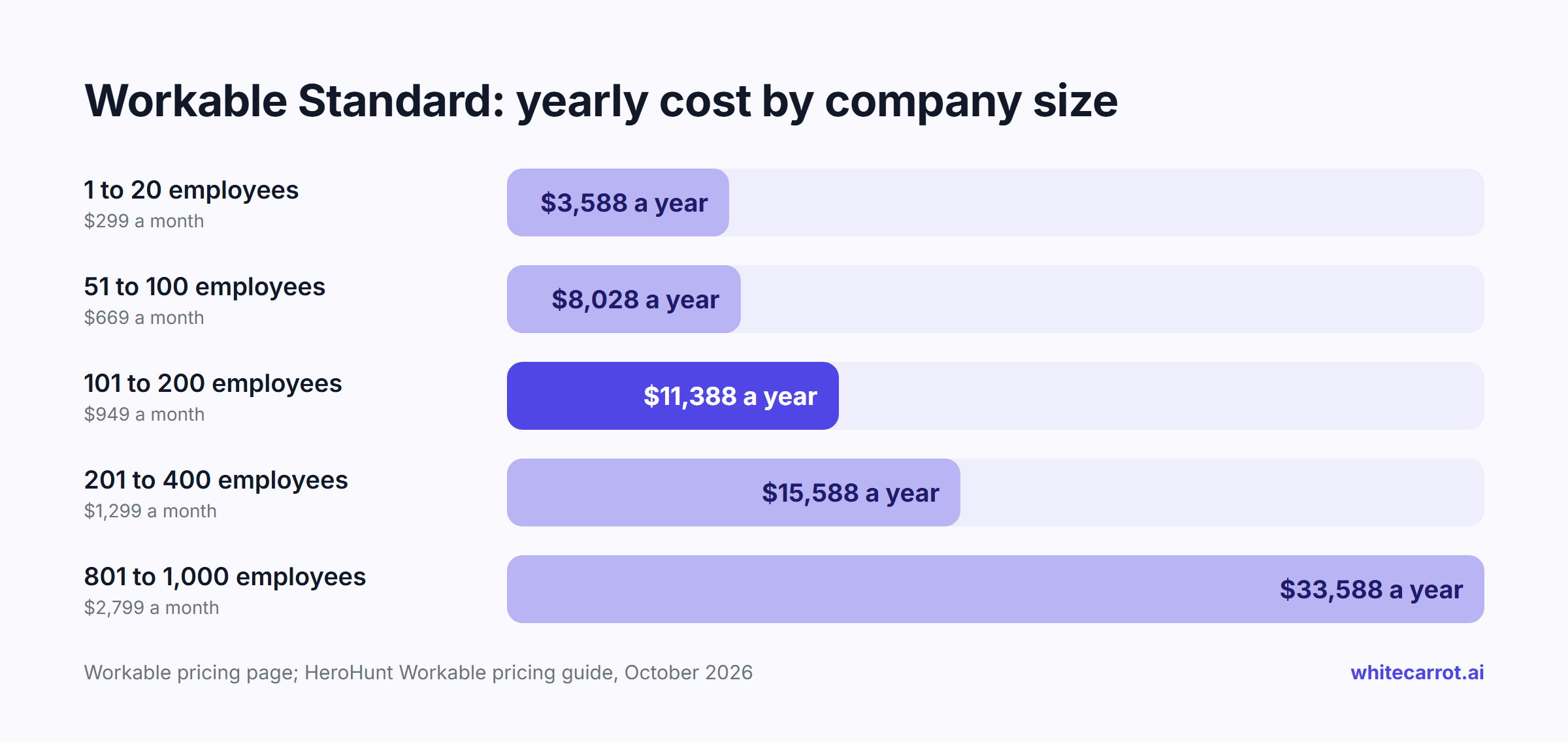
Workable pricing starts at $299 a month for Standard, $599 for Premier and $719 for Enterprise for a company of 1 to 20 employees, according to Workable’s pricing page. Every plan is priced by the number of employees in your company, not by the number of recruiters or hires. Standard can be billed monthly or annually, with annual billing saving 20%; Premier and Enterprise are annual only. On Standard, texting ($89 a month), video interviews ($109), assessments ($59) and performance reviews ($39) are add-ons; Premier and Enterprise include them. HeroHunt’s October 2026 Workable pricing guide lists the higher bands below, and notes that from 51 employees upward Premier costs less than Standard plus the three main add-ons.
Company size
Standard
Premier
Enterprise
1 to 20 employees
$299 a month
$599 a month
$719 a month
21 to 50 employees
$419 a month
$829 a month
$989 a month
51 to 100 employees
$669 a month
$1,229 a month
$1,469 a month
101 to 200 employees
$949 a month
$1,759 a month
$2,109 a month
201 to 400 employees
$1,299 a month
$2,269 a month
$2,719 a month
801 to 1,000 employees
$2,799 a month
$3,959 a month
$4,749 a month
1,000+ employees
Quote
Quote
Quote
Workable list prices per month on annual billing, before AI credits. Over a year, Standard comes to $3,588 at 1 to 20 employees, $8,028 at 51 to 100, $11,388 at 101 to 200, $15,588 at 201 to 400 and $33,588 at 801 to 1,000, so the same hiring volume costs more as a company grows.
Workable Standard list price on annual billing, before add-ons and AI credits. The same hiring volume costs more as headcount grows.
A 150-person company on Standard pays $949 a month, or $11,388 a year, before add-ons. The Workable Agent adds a usage line. Workable’s help center says the Job Brief Agent is free, while sourcing, screening and engagement use AI credits:
Included: 3,000 free AI credits for paid recruiting customers.
Usage: 1 credit to evaluate a candidate, 2 to source a passive candidate, 10 for a candidate chat.
Credit packs: 5,000 credits for $600, 10,000 for $1,000 and 50,000 for $4,750. Credits expire after a year and are non-refundable.
Screening 1,000 applicants for one busy role uses 1,000 credits, and chatting with 200 of them uses 2,000 more: the whole free allowance on a single role. Whitecarrot lists its platform plans on its pricing page, with AI CV credits and notetaker hours included in each plan. Managed Hiring is priced per placement, at one month's salary.
Workable review: what do users praise and criticise?
A fair Workable review starts with what it does well. Reviewers consistently praise an interface that hiring managers learn quickly, which matters when non-recruiters review candidates. HRD America’s 2023 review of Workable highlights posting to more than 200 job sites at once, anonymised screening, interview kits and scorecards, video interviews, and calendar links with Google and Outlook. It also notes support teams that answer calls and chats quickly. OutSail credits Workable's sourcing tools and its support for global hiring in several languages.
The criticisms are just as consistent across both reviews:
Customisation: fields and workflows are less configurable than in enterprise applicant tracking systems (OutSail).
Reporting: improving, but still limited (OutSail).
Candidate CRM: no dedicated CRM for nurturing past applicants (OutSail).
Search and AI access: search is limited, and many of the stronger AI features sit on upper-tier plans (HRD America).
Both reviews place Workable with small and mid-sized companies whose hiring process is simple. If your recruiters spend their week on screening and scheduling rather than on posting and tracking, those are the stages to compare most closely.
Does Workable work for hiring in the UAE and GCC?
Workable works for GCC employers that hire in English and post to global boards, with three things to check first. First, language: Workable's help center states that the Workable Agent does not yet support languages other than English, so it cannot screen or chat with candidates in Arabic. Second, job boards: Workable's job distribution page names Indeed and LinkedIn as partners but names no regional boards such as Bayt, GulfTalent or Naukrigulf, so confirm the boards you rely on are on its list before you sign. Third, the agent's limits: it engages only with candidates in the Applied and Sourced stages, and candidates created more than seven days before it was switched on are not screened automatically. Whitecarrot was built for GCC employers: it posts roles, pulls applicants from every channel into one pipeline, and screens them on video before a recruiter steps in.
When should you choose Workable, and when Whitecarrot?
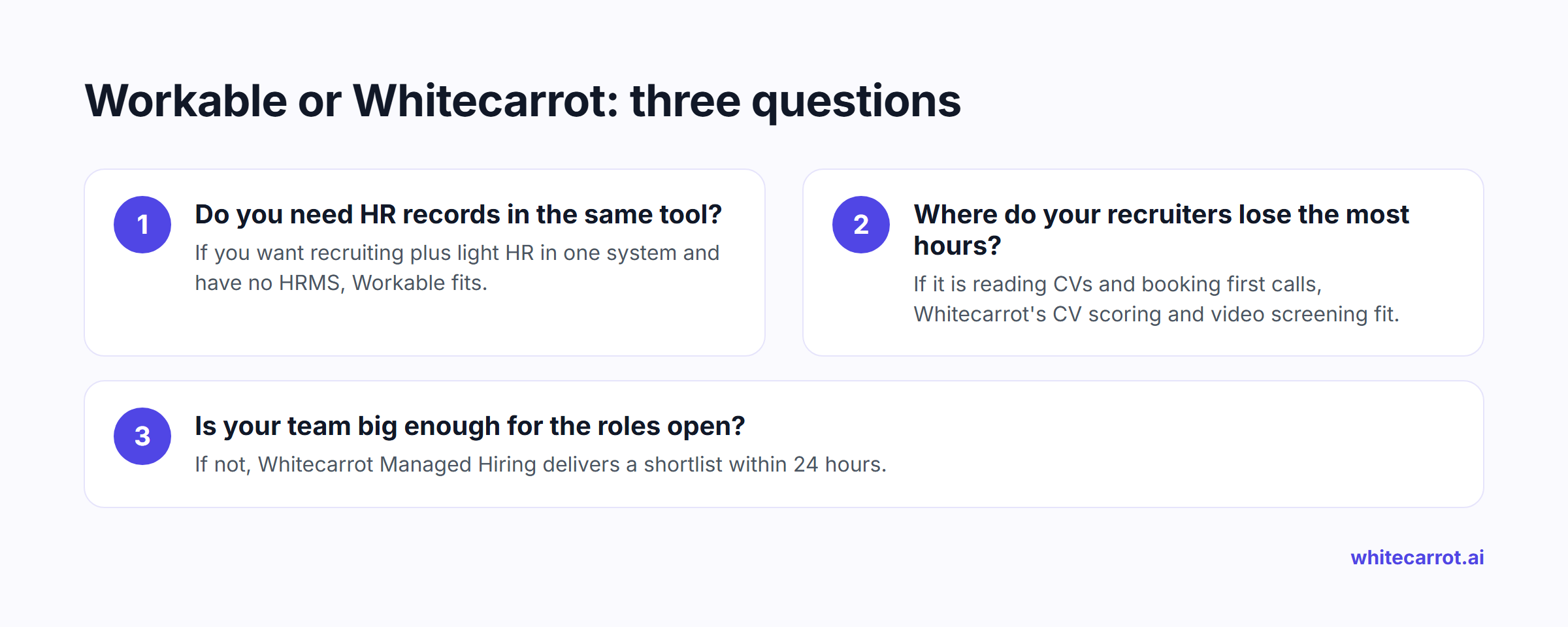
Choose Workable when you want one affordable system for recruiting and light HR, your hiring process is simple, and your recruiters have time to screen candidates themselves. Choose Whitecarrot when open roles are the bottleneck: when recruiters spend most of the week reading CVs and booking first calls, when you hire at volume in the GCC, or when you want the shortlist delivered for you. The table maps common situations to the better fit.
Your situation
Better fit
You want one tool for recruiting plus light HR (records, time off, onboarding)
Workable
Your hiring process is simple and hiring managers need a tool they learn in a day
Workable
Recruiters spend most of the week screening CVs and booking calls
Whitecarrot
You hire high volumes in the UAE or Saudi Arabia and need candidates screened on video
Whitecarrot
Your team is too small for the roles you have open
Whitecarrot Managed Hiring or Rent-a-Recruiter
You already run payroll and HR in a regional HRMS
Whitecarrot, alongside that HRMS
Answer these in order. Most teams know which tool fits by the second question.
What are the other Workable alternatives?
The right Workable alternatives depend on what you want to fix. Teams that need structured interviewing at scale usually compare Greenhouse and Ashby. Teams that want the lowest cost per recruiter look at tools priced per user rather than per employee, such as Manatal and Zoho Recruit. Teams that want AI to do more of the screening look at AI-first recruiting tools. Our guide to AI alternatives to ATS software compares the wider market, and our review of AI recruitment software alternatives covers the AI-first options. Before you switch, list the three stages where your team loses the most hours, then judge each Workable alternative on those stages, not on its feature list.
How does Whitecarrot help teams moving off Workable?
Whitecarrot takes the screening and scheduling work that Workable leaves to your recruiters. It scores every CV and screens candidates on one-way video, so recruiters meet only the strongest people. It joins interviews as an AI notetaker, collects structured feedback, and sends offers for e-signature before handing each hire to your HRMS. Alabbar Enterprises in Dubai went from 8 recruiters doing 350 hires a year to 3 recruiters doing 850. Beehive, a UAE fintech, moved off a manual process on BambooHR, and its hiring managers now fill junior roles without assigning a recruiter. For HR and talent leaders, our page for HR and TA leaders shows how teams set it up.
If you are weighing Workable vs Whitecarrot, run one live role through Whitecarrot and compare the shortlist. Book a demo to see it on your own role.
Frequently Asked Questions
Common questions about this topic answered below.
Is Whitecarrot an alternative to Workable?
Yes. Whitecarrot replaces Workable's recruiting side: it scores every CV, screens candidates on AI-assessed one-way video, schedules interviews, joins them as an AI notetaker and sends offers for e-signature. It does not include Workable's HR module, so companies keep their own HRMS for records, time off and payroll, and Whitecarrot hands each hire to it.
How much does Workable cost per month?
Workable costs $299 a month on Standard, $599 on Premier and $719 on Enterprise for a company of 1 to 20 employees, according to its pricing page. Prices rise with headcount: at 101 to 200 employees, Standard is $949 a month on annual billing. AI agent use beyond 3,000 free credits is extra, from $600 for 5,000 credits.
Does Workable's AI agent screen candidates in Arabic?
No. Workable's help center states that the Workable Agent does not yet support languages other than English. It also works only on candidates in the Applied and Sourced stages, and it does not automatically screen candidates created more than seven days before it was switched on. GCC teams hiring in Arabic should test this on a live role first.
Is Workable good for small businesses?
Workable suits small and mid-sized businesses with simple hiring processes, according to OutSail's review, which praises its easy interface and sourcing tools. It is priced by company headcount, from $299 a month for up to 20 employees, and includes light HR. Teams that need deep customisation, a candidate CRM or detailed reporting may find it limiting.
Table of Content
Skip the hiring hassle
See how Whitecarrot helps you source, screen, and hire faster with AI.