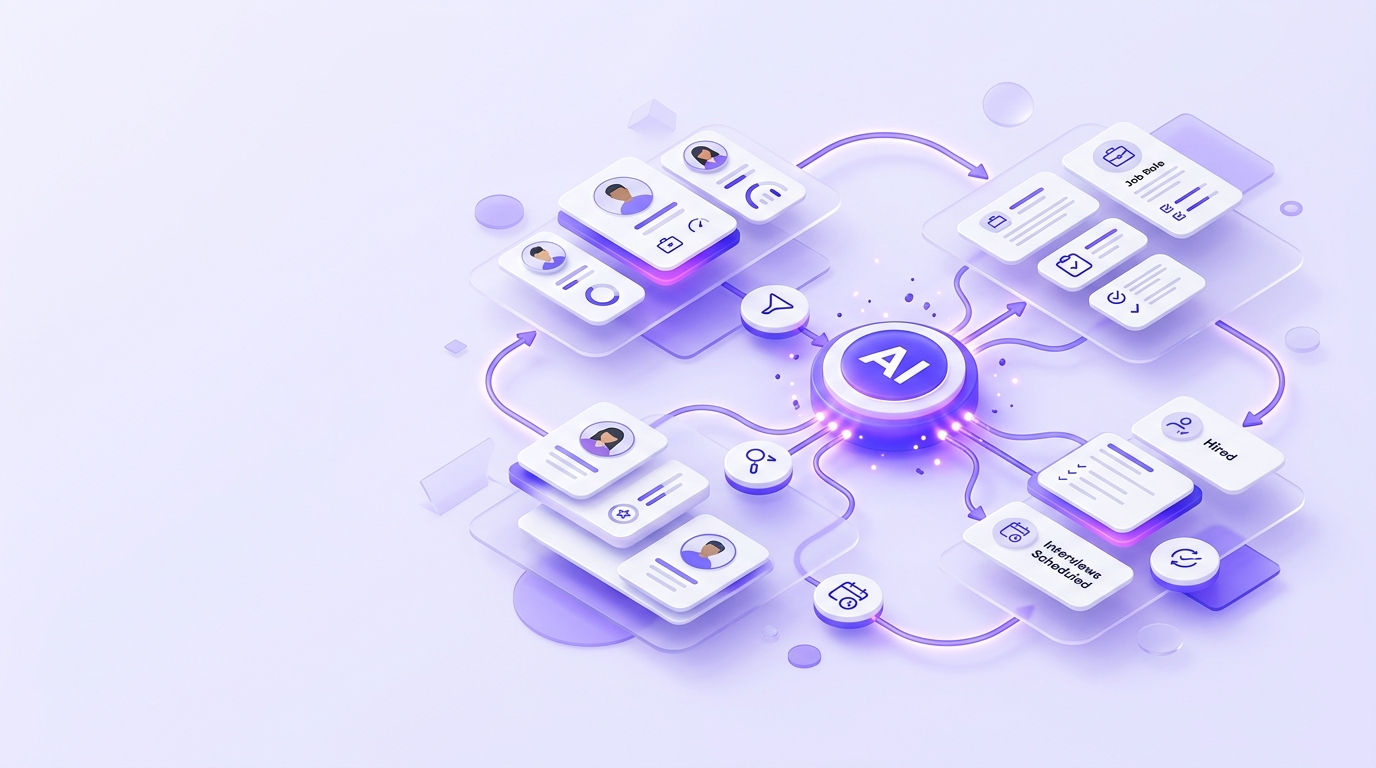
AI candidate sourcing is the use of artificial intelligence to find, match and rank people for an open role. Instead of a recruiter typing Boolean strings into one database at a time, the software reads the job, searches many sources at once, scores each profile against the requirements and returns a ranked shortlist, often with a drafted first message.
That sounds simple, but the tools behind it differ a lot. Some are search engines with a smarter query box. Others are agents that run the whole loop of searching, enriching, contacting and following up. This guide explains how AI finds candidates for you, how AI talent search differs from Boolean search, what an AI agent for headhunting can and cannot do alone, the data rules that apply in the UAE and wider GCC, and what to check before you buy.
What is AI candidate sourcing?
AI candidate sourcing is the search-and-match stage of hiring, handed to software. A recruiter or hiring manager describes the role in plain language or pastes the job description. The AI then turns that brief into searches, looks across talent databases, professional networks, public profiles and the company's own applicant records, and returns the people who best fit. Each person comes with a fit score and, in better tools, a short reason for the match. AI candidate sourcing is different from screening: sourcing decides who enters the pipeline, while screening judges the people already in it. It is also different from an applicant tracking system, which stores jobs and candidates but does not go looking for them. The goal of AI candidate sourcing is not more names. It is fewer, better-matched names, delivered faster than a person could build the same list by hand.
How does AI find candidates for you?
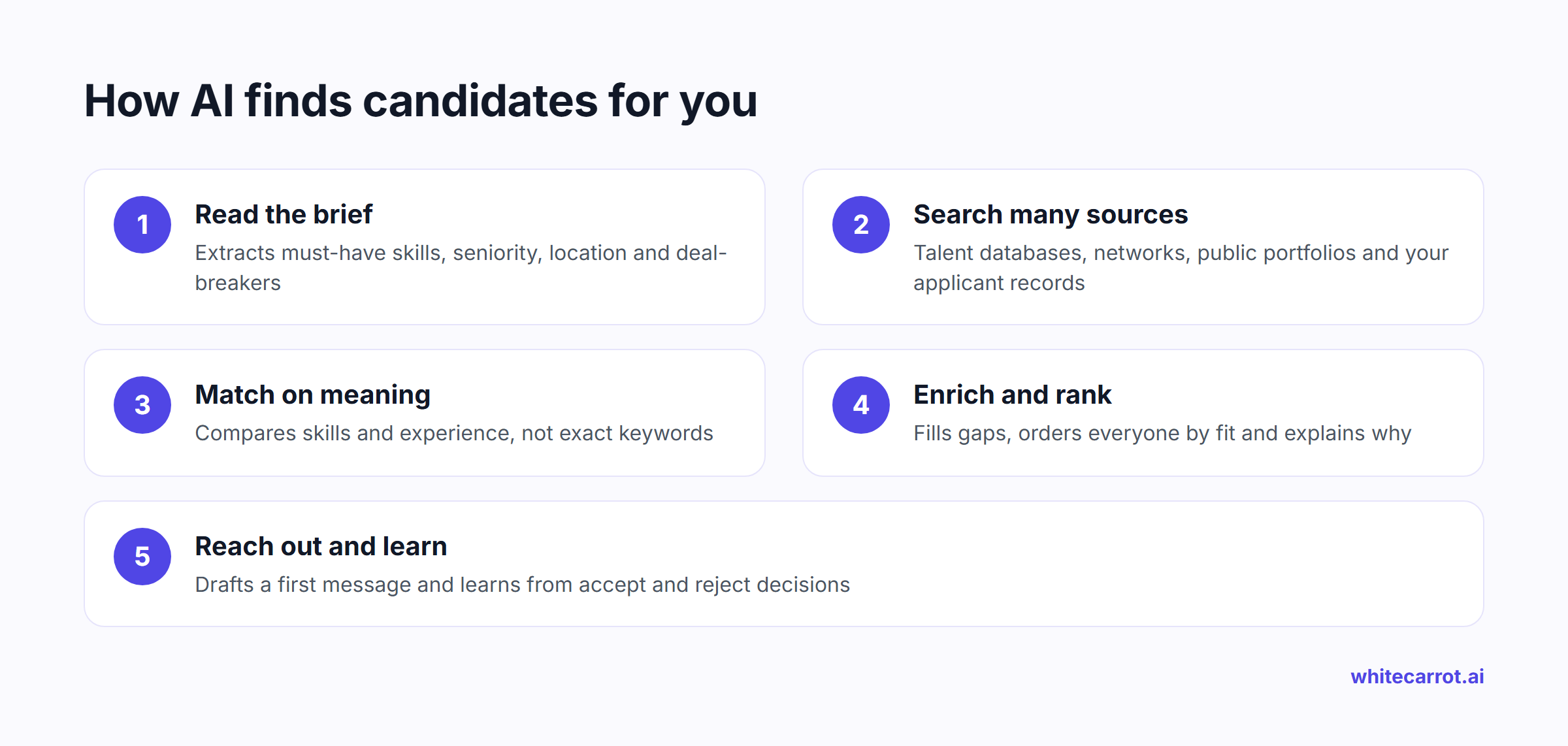
Most AI candidate sourcing tools follow the same five steps, whatever they call them. An AI agent for finding candidates runs these steps in a loop, learning from which profiles the recruiter accepts or rejects.
Read the brief. The AI extracts must-have skills, seniority, location, languages and deal-breakers from the job description or a short prompt.
Search many sources. It queries talent databases, professional networks, public portfolios and your existing applicant records in parallel.
Match on meaning. It compares profiles to the brief by skills and experience, not exact keywords, so "payroll lead" and "compensation and payroll manager" both count.
Enrich and rank. It fills gaps such as current employer and contact route, then orders everyone by fit and explains why.
Reach out and learn. It drafts a personalised first message, schedules follow-ups, and uses the recruiter's accept and reject decisions to sharpen the next search.
The five steps most AI candidate sourcing tools run in a loop.
The order matters. Tools that skip step one produce long lists of near-misses, and tools that skip step five never get better at your roles. When you assess a vendor, ask to watch all five steps run on one of your own open jobs.
How is AI talent search different from Boolean search?
AI talent search replaces the Boolean string with a description of the person you want. A Boolean search only returns profiles that contain the exact words you typed, joined by AND, OR and NOT, so the quality of the list depends on how well the recruiter guesses the words candidates use. AI talent search uses language models to understand the intent behind the request and to match on related skills, job titles and career paths. It can also rank results, where Boolean search only filters them. Boolean search still has a place: it is precise, transparent and good for narrow, well-defined roles. Many teams use AI talent search to build the first list and Boolean filters to tighten it.
Boolean search
AI talent search
Input
A string of keywords with AND, OR, NOT
A plain-language brief or the job description
Matching
Exact words only
Meaning: related skills, titles and career paths
Output
An unranked list that passes the filter
A ranked list with a reason for each match
Sources
Usually one database per search
Several sources searched at once
Skill needed
High: results depend on the string
Lower: results depend on a clear brief
Best for
Narrow roles with standard titles
Roles with varied titles, or a broad first pass
What can an AI agent for headhunting do on its own?
An AI agent for headhunting goes further than search. A search tool waits for a query and returns results; an agent takes a goal, such as "build a shortlist of ten senior finance controllers in Riyadh", and carries out the connected steps itself within the permissions it is given. In practice an AI agent for headhunting can:
map a target market: which companies employ people with the profile you need, and roughly how many;
run searches across several sources and remove duplicates;
enrich profiles with current role, tenure and a contact route;
draft and send a personalised first message, then follow up on a schedule;
re-check your own database for past applicants who now fit a new role.
What it should not do alone is decide who gets hired. The recruiter still owns the brief, the sensitive context (a confidential replacement, a salary ceiling), the decision to contact someone, and every judgement about fit. Sapia's 2026 guide makes the same point: sourcing runs on inferred signal such as CVs and profiles, which is good for finding people and weak for ranking them, so a measured step like a structured interview should follow (Sapia, AI candidate sourcing in 2026). For how agents work across the whole funnel, see our guide to what an AI recruitment agent is and how it works.
Where do AI-sourced candidates come from?
AI-sourced candidates come from three pools: external databases and networks, the public web, and the company's own records. The third pool is the one most teams under-use. According to Gem's 2026 Recruiting Benchmarks report, which covers over 165 million applicants and 1.2 million hires, nearly half (46%) of sourced hires now come from rediscovered candidates already in a company's ATS or CRM, up from 26% in 2021. That means a good AI candidate sourcing tool should search your past applicants first, before paying to reach strangers. People who applied for a different role last year, reached a final round, or were a near-miss already know your brand. A tool that cannot read your applicant history is leaving the cheapest source untouched. If LinkedIn is your main external channel, our guide to AI agents for LinkedIn recruitment covers that source in depth.
Nearly half of sourced hires now come from people already in the company's ATS or CRM.
Is AI candidate sourcing worth it?
AI candidate sourcing is worth it when a team has more roles than recruiter hours, or when good people are not applying. The same Gem report found that sourced candidates are nearly eight times more likely to be hired than inbound applicants, and that recruiters are handling 93% more applications than in 2021, while only 8% of applicants advance past initial screening. Volume is not the problem; relevance is. The main benefits are:
Speed: a first shortlist in minutes rather than days of manual searching.
Reach: passive candidates who would never see a job post.
Consistency: every profile is checked against the same requirements.
Rediscovery: past applicants resurface automatically for new roles.
The limits are real too. AI ranks on the data it can see, so career changers and people with thin online profiles can be missed. Models trained on past hiring decisions can repeat past bias. Automated outreach that reads as generic damages your employer brand. And a sourcing tool that is not connected to screening simply moves the bottleneck one step down the funnel.
What types of AI sourcing tools are there?
AI sourcing tools fall into five broad types, and many products combine two or three. Sapia's 2026 tool map groups the market in a similar way. The right type depends on whether your problem is finding people, reaching them, or handling the ones who already applied.
Type
What it does
Best for
Talent search engine
Searches a large indexed database of profiles with AI ranking
Recruiters who source every day across many roles
Professional network tools
AI search and messaging inside one network
Teams whose candidates are concentrated on one network
Talent CRM
Stores past applicants and prospects, runs nurture and rediscovery campaigns
Companies with a large applicant history
Talent intelligence platform
Market maps, skills data and internal mobility
Large employers planning workforce shifts
Agentic sourcing tool
Takes a goal and runs search, enrichment and outreach end to end
Small teams with hard-to-fill roles
Pricing across these types is mostly per seat or per contact credit, and many vendors do not publish it. Ask for the price at your real volume, including outreach credits, before comparing tools.
Is AI candidate sourcing legal in the UAE and GCC?
AI candidate sourcing is legal in the UAE, but the data it touches is regulated. The UAE's Federal Decree-Law No. 45 of 2021 on the Protection of Personal Data applies to personal data processed by electronic systems inside or outside the country, and it prohibits processing personal data without the owner's consent except in specific cases. It also gives people the right to correct their data and to restrict or stop processing, and it sets rules for cross-border transfers. Companies in the Dubai International Financial Centre fall under the separate DIFC Data Protection Law, DIFC Law No. 5 of 2020. For employers hiring into Europe as well, the EU AI Act lists AI systems used "to analyse and filter job applications, and to evaluate candidates" as high-risk in Annex III. In practice, ask every vendor where candidate data is stored, how a candidate can ask to be removed, and whether outreach records the lawful basis for contact. This is general information, not legal advice.
How do you choose an AI candidate sourcing tool?
Choose an AI candidate sourcing tool by testing it on your own roles, not the vendor's demo role. Use this checklist:
Source coverage: does it search the networks your candidates actually use in the GCC, plus your own applicant history?
Match explanations: does every suggested candidate come with a reason you can check?
Connection to the rest of hiring: do sourced candidates land in your ATS with their history, or in a separate spreadsheet?
Outreach quality: can you edit the first message, and does it sound like your team?
Data handling: where is data stored, how are removal requests handled, and is consent recorded?
Pricing at your volume: seats, credits and the cost of reaching one more candidate.
Run a two-week pilot on two or three live roles and measure qualified yield: the share of AI-suggested candidates a recruiter would actually contact. If that share does not beat your current manual sourcing, the tool is adding names, not value. Pair it with AI resume screening so the people you find are judged the same way as everyone who applies.
How does Whitecarrot help you find the right candidates?
For most employers in the GCC the first problem is not too few candidates but too many unsorted ones, spread across job boards, email and referrals. Whitecarrot's AI recruiter starts there. It writes the job, posts it to job boards and aggregates every applicant into one pool, then scores each CV against the role and builds a ranked shortlist. Shortlisted candidates go through AI-assessed one-way video screening, and the same record moves on to interview scheduling with Google or Outlook, AI notetaking, structured feedback and offers by e-signature. If you need a job description to start from, try our free AI job description generator.
More than 88 companies across the GCC hire on Whitecarrot, and customers have cut time to hire from 45 days to under 20. Alabbar Enterprises in Dubai went from 8 recruiters making 350 hires a year to 3 recruiters making 850. For roles where you would rather hand the search to people, Managed Hiring delivers a shortlist within 24 hours.
Book a demo to see how Whitecarrot turns one open role into a ranked, screened shortlist.
Frequently Asked Questions
Common questions about this topic answered below.
Can AI find passive candidates?
Yes. AI candidate sourcing tools search professional networks, public profiles and your own applicant history, so they surface people who are not applying for jobs. They rank those people by fit and can draft a first message. A recruiter should still decide who to contact and personalise the outreach, because passive candidates respond to relevant, human messages.
Will AI replace recruiters in sourcing?
No. AI replaces the slowest part of sourcing, building and filtering long lists, but not the judgement. Recruiters still own the brief, sensitive context such as salary limits or confidential searches, the decision to contact someone and every assessment of fit. Teams that use AI well spend less time searching and more time talking to candidates.
What is the difference between AI sourcing and AI screening?
AI sourcing decides who enters your pipeline: it finds and ranks people who have not applied yet. AI screening judges people already in the pipeline: it scores CVs, runs assessments or video screens against the role. Most teams need both, connected in one system, so sourced candidates and applicants are judged against the same requirements.
How much do AI candidate sourcing tools cost?
AI candidate sourcing tools are usually priced per recruiter seat, per contact credit, or both, and many vendors do not publish prices. Costs rise with outreach volume and extra data such as verified contact details. Ask each vendor for a quote at your real number of roles and messages, and compare it with what you spend on agencies today.
Table of Content
Skip the hiring hassle
See how Whitecarrot helps you source, screen, and hire faster with AI.