The main recruitment agent alternatives for GCC employers are an in-house team on an AI recruiter platform, recruitment process outsourcing (RPO), managed hiring on a fixed fee, and direct channels such as job boards and referrals. Each one replaces the 15% to 25% placement fee that recruitment agents in the UAE commonly charge with a cost you can plan.
This guide covers what a recruitment agent costs in the UAE, how each alternative compares on price and speed, the features to check before you sign, and when an agent is still the right call. It is written for HR leaders, talent acquisition heads and founders hiring in the UAE, Saudi Arabia and the wider GCC.
What is a recruitment agent, and why do GCC employers look for alternatives?
A recruitment agent is a recruiter, usually working for a licensed agency, who finds and shortlists candidates for an employer and is paid a fee when one is hired. In the UAE, recruitment agencies are licensed by the Ministry of Human Resources and Emiratisation (MOHRE). Article 6 of Ministerial Resolution No. 1283 of 2010 bars agencies from taking any commission or fee from the worker, so the employer pays the whole fee. MOHRE updated the rules for recruitment, mediation and outsourcing agencies in a February 2022 ministerial resolution under the new UAE Labour Law.
GCC employers look for recruitment agent alternatives for three reasons. The fee is large and recurs on every hire. The agent controls the candidate pipeline, so the company learns little from each search. And a growing share of the screening and scheduling work an agent does by hand can now be done by software. The term has also split in two: "recruitment agent" now also means an AI recruitment agent, software that runs parts of the hiring process. Our guide to how an AI recruitment agent works covers that meaning in depth.
What are the best recruitment agent alternatives for GCC employers?
The best recruitment agent alternative depends on how often you hire and who owns the process. Companies hiring every month usually save most by bringing hiring in-house on an AI recruiter platform. Companies with a temporary spike are better served by RPO or a rented recruiter. Companies that want an agency-style result without the agency fee can use managed hiring on a fixed fee. Direct channels such as job boards and referrals work best for volume roles. Executive search remains a separate case for senior hires. The table below compares the six options on how you pay, typical cost and fit.
Option
How you pay
Typical cost
Best for
Watch out for
Contingency recruitment agent
Fee on placement
Commonly 15% to 25% of annual salary
Hard-to-fill or one-off roles
Fee basis (basic or package) and short guarantees
In-house team on an AI recruiter platform
Software subscription plus team salaries
Fixed monthly cost, no per-hire fee
Steady hiring of 1+ roles a month
Needs someone to own the process
RPO or rent-a-recruiter
Monthly fee or per-role fee
Depends on scope and term
Hiring spikes, new markets, projects
Minimum terms that outlast the spike
Managed hiring (fixed fee)
Flat fee on placement
For example, one month's salary
Teams that want an agency-style result at a lower fee
What the guarantee covers
Job boards and referrals
Per post or referral bonus
Qureos lists AED 800 to AED 6,500 per job post
High-volume and entry-level roles
Screening hundreds of CVs by hand
Executive search
Retainer plus completion fee
Higher than contingency
C-suite and scarce specialists
Paying the retainer whether or not you hire
1. An in-house team on an AI recruiter platform
An AI recruiter platform gives a small HR team the reach an agent offers: it posts jobs to boards, aggregates applicants, scores every CV against the requirements and runs one-way video screening. The team pays a subscription instead of a fee per hire, so the cost per hire falls as volume rises.
2. RPO or rent-a-recruiter
Recruitment process outsourcing puts an external recruiter or team inside your process for a period. It suits launches, new markets and seasonal peaks. Our guide to RPO in the UAE covers the pricing models and contract terms.
3. Managed hiring on a fixed fee
Managed hiring works like an agency, since a provider delivers the shortlist, but the fee is fixed and lower. The provider uses software for the screening work, which is where the saving comes from.
4. Job boards, referrals and your careers page
Direct channels cost the least per hire but need the most screening time. They work well for entry-level and high-volume roles, as long as someone can handle the applications.
5. Executive search
For C-suite and scarce specialist roles, a retained search firm is still often the right choice. It is a different service from contingency recruitment, with a higher fee and a deeper search.
How does recruitment agent pricing compare in the UAE?
Recruitment agent pricing in the UAE is usually a percentage of the hire's first-year salary, paid by the employer on placement. TASC Outsourcing, a UAE staffing provider, puts the typical range at 15% to 25% of annual salary in its guide to choosing an agency. The Qureos UAE recruitment cost calculator gives a wider range of 8% to 25%, and estimates 40 to 80 hours of internal HR time per hire and an average time to hire of 47 days. Fixed fees and monthly retainers also exist, mostly for specialist or senior searches. Two details move the real cost more than the headline rate: whether the percentage applies to basic salary or the full package, and how long the replacement guarantee lasts.
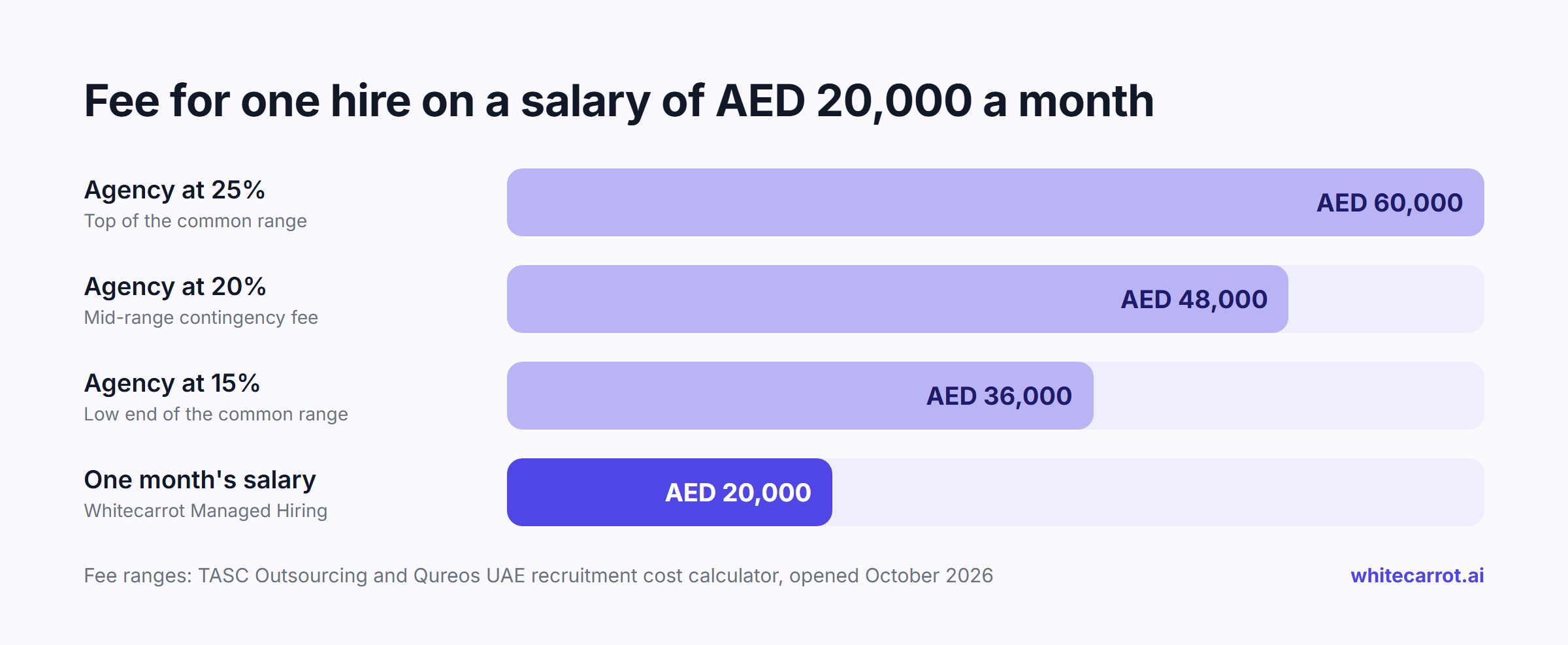
A worked example makes the gap clear. Take a hire on AED 20,000 a month, or AED 240,000 a year:
At 15%, the agency fee is AED 36,000.
At 20%, it is AED 48,000.
At 25%, it is AED 60,000.
A fixed fee of one month's salary is AED 20,000.
The same AED 240,000-a-year hire costs three times more at the top of the agency range than on a one-month fee.
Across ten hires a year at that salary, the gap between a 20% agency fee and a one-month fee is AED 280,000. That figure is the budget that the alternatives in this guide compete for.
What are the benefits of a recruitment agent, and when is one still the right call?
The benefits of recruitment agent services are real, and a fair comparison should start with them. A good recruitment agent brings a network of passive candidates who are not applying to job ads. The agent also knows local salary levels and can move fast on a role your team has never hired for. Because a contingency agent is paid only on placement, you carry no cost if the search fails. For a one-off senior role, a niche specialist, or a hire in a GCC country where you have no presence, those benefits can justify the fee.
A recruitment agent is a weaker fit when you hire the same kinds of roles every month. In that case you pay the full fee again for work that a platform or an in-house recruiter could repeat at a fixed cost. You also end each search without the candidate data, which stays with the agency.
Which recruitment agent features matter most for HR teams?
The recruitment agent features that matter most for HR teams are the ones that set the real cost and the real risk, not the size of the agency's database. Whether you are reviewing a human recruitment agent or an AI recruitment agent, check the same six things: the licence, the fee basis, the replacement guarantee, the speed to a first shortlist, whether you can see the whole pipeline, and depth in your GCC market. A recruitment agent for HR teams should make your team's work lighter, so ask how candidates, feedback and offers reach your own systems.
Feature
Why it matters
What good looks like
MOHRE licence
UAE law requires one and bans charging candidates
Licence number on the contract
Fee basis in writing
15% of a full package is far more than 15% of basic pay
One percentage, one salary definition
Replacement guarantee
Protects you if the hire leaves early
A stated period, such as 90 days, with a free replacement
Time to first shortlist
Shows whether the agent has a real network
A shortlist in days, not weeks
Pipeline visibility
You should see every candidate submitted, not only the finalists
Candidates land in your own ATS
GCC market depth
Emiratisation, Saudisation and visa rules change the shortlist
Placements in your country and sector
How do you run a recruitment agent review before you sign?
A recruitment agent review should test the agent on your roles, not on their pitch deck. Run every agency, and every alternative, through the same five checks:
Check the licence. Confirm the agency holds a MOHRE recruitment licence and never charges candidates.
Pin down the fee basis. Ask for the percentage and whether it applies to basic salary or the full package.
Read the guarantee. Get the replacement period and the refund terms in writing.
Test on one live role. Judge the first shortlist on quality and speed before giving more roles.
Compare the total cost. Put the fee next to an in-house, RPO or managed-hiring option for the same role.
Run every agency and every alternative through the same five checks.
How is AI changing the work of a recruitment agent?
AI is taking over the repetitive half of a recruitment agent's job: screening CVs, first-round interviews and scheduling. According to LinkedIn's The Future of Recruiting 2025 report, 37% of organisations are now integrating or experimenting with generative AI in hiring, up from 27% a year earlier. Teams that do so save about 20% of their work week on average. For a GCC employer, that shifts the question from "which agent?" to "which parts of hiring still need a person?"
The answer is usually the judgement calls: the final interviews, the offer and the conversation that convinces a passive candidate to move. An AI recruiter can score and shortlist applicants and run AI-assessed video screening, so your recruiters spend their time on those calls.
Where does Whitecarrot fit as a recruitment agent alternative?
Whitecarrot gives GCC employers three recruitment agent alternatives under one brand, so you can match the model to the role:
AI Recruiter platform: run hiring yourself. It plans the requisition, posts to job boards, scores CVs, runs AI-assessed one-way video screening, schedules interviews in Google or Outlook, takes interview notes and manages offers through e-signature.
Managed Hiring: done for you, with a shortlist within 24 hours, a placement fee of one month's salary and a 90-day replacement guarantee.
More than 88 companies across the GCC hire with Whitecarrot, and time to hire has dropped from 45 days to under 20. Alabbar Enterprises in Dubai went from 8 recruiters doing 350 hires a year to 3 recruiters doing 850 on the platform. If you are weighing an agency for your next roles, compare Whitecarrot's hiring services or see the platform plans.
Which recruitment agent alternative should you choose?
Choose by hiring volume first. If you hire one or more people a month, an in-house team on an AI recruiter platform is usually the best recruitment agent alternative, because the cost stays flat as you grow. If you have a short spike, rent a recruiter or use RPO. If you want an agency's result at a lower fee, use managed hiring. Keep a recruitment agent, or a retained search firm, for the senior and niche roles where their network earns the fee.
Frequently Asked Questions
Common questions about this topic answered below.
How much does a recruitment agent charge in the UAE?
A recruitment agent in the UAE usually charges the employer a percentage of the hire's first-year salary. Published ranges run from about 8% to 25%, with 15% to 25% the most common for professional roles. Executive and specialist searches often cost more. Always confirm whether the percentage applies to basic salary or the full package.
Who pays the recruitment agent's fee in the UAE?
The employer pays. UAE rules bar licensed recruitment agencies from taking any commission or fee from the worker, directly or through an intermediary. If an agency asks a candidate for registration, visa or placement fees, that is a red flag.
Can AI replace a recruitment agent?
AI can replace much of a recruitment agent's routine work, such as screening CVs, first-round video interviews and scheduling. It does not yet replace the relationships an agent uses to move passive candidates or the judgement in final interviews. Many GCC employers now use an AI recruiter in-house and keep agents for senior or niche roles.
What is the difference between a recruitment agent and RPO?
A recruitment agent fills individual roles and is paid per placement, usually a percentage of salary. Recruitment process outsourcing (RPO) takes over part or all of your hiring process for a period, for a monthly or per-role fee. RPO suits ongoing or high-volume hiring, while an agent suits occasional, hard-to-fill roles.
Table of Content
Skip the hiring hassle
See how Whitecarrot helps you source, screen, and hire faster with AI.