An AI agent for hiring performance is software that runs parts of the hiring process itself, such as CV screening, interview scheduling, interview notes and candidate updates, and records every step it takes. Because the agent logs its own work, you can measure hiring speed, quality and cost as they happen instead of rebuilding them from spreadsheets at quarter end.
This guide is for HR leaders and talent acquisition heads who already use, or are about to buy, AI hiring automation. It covers which metrics to track, what to compare them against, how to run a fair 90-day test and where AI agents still need a person watching.
What is an AI agent for hiring performance?
An AI agent for hiring performance is an AI recruiter that does hiring work and produces the hiring analytics to judge that work. A traditional applicant tracking system stores what recruiters type in. An AI agent acts: it posts the job, collects applicants from every board, scores each CV against the role, runs one-way video screening, books interviews in Google or Outlook calendars, joins the interview as a notetaker and collects structured feedback. Every one of those actions carries a timestamp, so the agent knows how long each stage took, where candidates dropped out and which hiring manager is slow to give feedback. That is the difference that matters for performance: the data is a by-product of the work rather than a reporting chore. The question for a buyer is not only whether the agent saves time, but whether its decisions hold up, and that needs its own set of metrics.
In practice, an agent covers these stages of recruitment workflow automation:
Plan: drafts the requisition and job description.
Attract: posts to job boards and pulls every applicant into one pipeline.
Shortlist: scores CVs and screening answers against the role's criteria.
Interview: schedules, takes notes and gathers scorecards.
Hire: sends offers for e-signature and hands over to onboarding.
Why do traditional hiring metrics fall short for AI hiring automation?
Traditional hiring metrics fall short for AI hiring automation because they measure outcomes and not the system that produced them. If time to hire drops, a dashboard cannot tell you whether the agent screened well, whether a recruiter worked weekends, or whether the market simply got easier. Most teams also struggle with the metric that matters most. According to LinkedIn's Future of Recruiting 2025 report, 89% of talent acquisition professionals agree that measuring quality of hire will become more important, yet only 25% feel highly confident in their organisation's ability to do it. The same report found that 61% believe AI can improve how they measure quality of hire. Speed metrics alone can also mislead: Robert Half recommends pairing time to hire with quality of hire and assessment effectiveness, because a fast process that produces poor hires is not an improvement.
The fix is to measure the agent in layers. Carv's AI impact framework makes the same point: judge what the AI executes, how people work with it, and only then the business result.
Which metrics should you track for an AI hiring agent?
The metrics to track for an AI hiring agent fall into three tiers: agent execution, human-AI collaboration and business results. Agent execution metrics show whether the agent does its assigned tasks correctly, such as how often recruiters override its shortlist. Collaboration metrics show whether recruiters and hiring managers actually work faster with it, such as time to feedback after an interview. Business results show whether hiring improved, such as time to hire, cost per hire and quality of hire. Track the first tier weekly, because problems there spread quickly into everything else. Review the second and third tiers monthly, and quality of hire quarterly, because new hires need time before their performance can be judged. Eleven metrics is enough. More than that and nobody reads the dashboard.
Tier
Metric
What it tells you
Review
Agent execution
Task completion rate
Share of assigned steps (screening, scheduling, notes, status emails) the agent finished without a person stepping in
Weekly
Agent execution
Override rate
How often recruiters reverse the agent's shortlist or score. A high rate means the scoring criteria need work
Weekly
Agent execution
Screening agreement rate
How often the agent's shortlist matches the hiring manager's own picks on a sample of CVs
Weekly
Collaboration
Time to feedback
Hours between an interview ending and structured feedback being recorded
Weekly
Collaboration
Recruiter hours on admin
Time spent on scheduling, chasing and data entry, before and after
Monthly
Collaboration
Hiring manager satisfaction
A short quarterly rating of shortlist quality and speed
Quarterly
Business results
Time to hire
Days from a candidate entering the pipeline to accepting the offer
Monthly
Business results
Cost per hire
Total spend on tools, ads, agency fees and recruiter time divided by hires
Monthly
Business results
Interview-to-offer ratio
Interviews needed per offer. Better screening lowers it
Monthly
Business results
Offer acceptance rate
Share of offers signed
Monthly
Business results
Quality of hire
90-day manager rating and 6 to 12-month retention of hires the agent screened
Quarterly
The two agent metrics most teams forget
Override rate and screening agreement rate are the honest tests of an AI shortlist. Take a sample of 30 to 50 CVs for one role, ask the hiring manager to pick their shortlist blind, and compare it with the agent's. If the two disagree often, the agent's criteria do not match what the manager really wants, and fixing the job criteria will do more than any other change. Our guide to AI resume screening explains how scoring criteria are set.
What benchmarks should you compare an AI hiring agent against?
The most useful benchmark for an AI hiring agent is your own baseline from before it went live, because role mix, seniority and location change every number. External figures are still useful as a sense check. SHRM's recruiting benchmarking data puts the median time to fill for non-executive roles at 39 calendar days. Robert Half says most hiring teams regard an interview-to-offer ratio of about 3:1 as good, so a ratio well above that points to weak screening. LinkedIn's 2025 research found that recruiters using generative AI save about 20% of their work week, roughly a full day. Treat these as reference points rather than targets. A hospitality group hiring hundreds of frontline staff and a fintech hiring five engineers will never share a time to hire.
How do you measure an AI agent's hiring performance?
You measure an AI agent's hiring performance by running a controlled before-and-after test on a defined set of roles over 90 days. Record a baseline first, change one thing at a time, and check the agent's own decisions before you credit it with business results. The six steps below work for a 50-person company and a 5,000-person group alike. The key discipline is to start the baseline before the agent goes live; many teams skip it, and then have nothing to compare against when the CFO asks what the software returned.
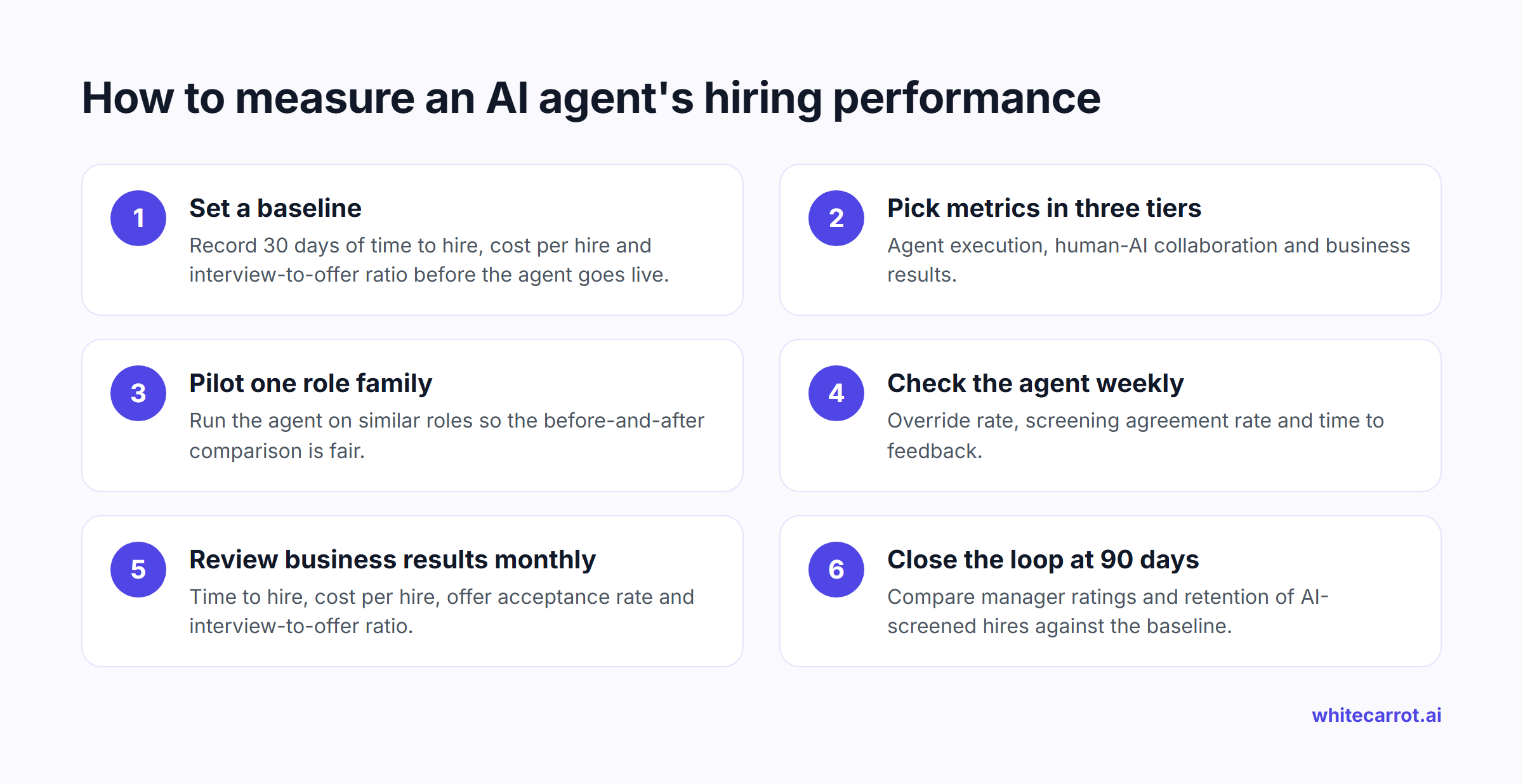
Set a baseline. Record 30 days of time to hire, cost per hire and interview-to-offer ratio before the agent goes live.
Pick metrics in three tiers. Agent execution, human-AI collaboration and business results, as in the table above.
Pilot one role family. Run the agent on similar roles, such as sales or customer service, so the before-and-after comparison is fair.
Check the agent weekly. Look at override rate, screening agreement rate and time to feedback, and fix criteria early.
Review business results monthly. Time to hire, cost per hire, offer acceptance rate and interview-to-offer ratio.
Close the loop at 90 days. Compare manager ratings and retention of AI-screened hires against the baseline.
Six steps to measure an AI hiring agent, from baseline to 90-day review.
How does hiring analytics change when an AI agent runs the workflow?
Hiring analytics changes in three ways when an AI agent runs the recruitment workflow: the data is complete, it is current, and it can be traced to a cause. In a manual process, analytics depends on recruiters updating the applicant tracking system, so stages are skipped, dates are approximate and interview feedback sits in email. When an agent moves the candidate, books the interview and collects the scorecard, each event is logged as it happens. That makes stage-by-stage conversion reliable, so you can see, for example, that candidates wait four days for a second interview with one manager. It also makes attribution possible: if the agent's screening changed in week three and the interview-to-offer ratio improved in week five, the timeline shows it. The limit is quality of hire, which still needs a manager's rating and retention data from your HR system.
Complete: every stage change is recorded by the system, not typed in later.
Current: dashboards reflect today's pipeline, not last month's export.
Traceable: changes in results can be matched to changes in the process.
Where do AI hiring agents still need human oversight?
AI hiring agents still need human oversight on final decisions, fairness and data handling. An agent can rank 900 applicants in minutes, but a person should approve every rejection rule and every final offer. Fairness needs active checking: compare pass-through rates at each stage across candidate groups, and investigate any stage where one group drops out far more often. Regulators treat this area as sensitive. The EU AI Act lists AI systems used for recruitment or selection as high-risk, including systems that filter applications and evaluate candidates, which matters for any GCC or Asian employer hiring from Europe. Candidate disclosure matters too: telling applicants that AI assists screening, and that a person reviews decisions, protects both trust and your candidate experience score.
A simple rule works for most teams: the agent recommends, a person decides, and the override rate tells you how much the two agree.
How does Whitecarrot measure an AI agent's hiring performance?
Whitecarrot's AI Recruiter platform runs the hiring workflow end to end, from planning the requisition to e-signed offers and HRMS onboarding, and logs every step so the metrics above come built in. More than 88 companies across the GCC run hiring on Whitecarrot. On average, customers have cut time to hire from 45 days to under 20, time to plan from 21 days to 6, and time to productivity from 135 days to 45. Alabbar Enterprises in Dubai went from 8 recruiters making 350 hires a year to 3 recruiters making 850, with time to hire falling from 44 days to 2.
The AI shortlisting stage scores every applicant against the role, and the AI interview stage records notes and structured feedback, which is where override rate and time to feedback come from. If you lead HR or talent acquisition, our page for HR and TA leaders shows how teams use these reports. To see the dashboards on your own roles, book a demo.
Frequently Asked Questions
Common questions about this topic answered below.
What metrics measure an AI agent's hiring performance?
The metrics that measure an AI agent's hiring performance come in three tiers. Agent execution covers task completion, override rate and screening agreement. Collaboration covers time to feedback and recruiter admin hours. Business results cover time to hire, cost per hire, interview-to-offer ratio, offer acceptance and quality of hire. Review the first tier weekly and quality of hire quarterly.
How do you measure quality of hire when using AI?
Measure quality of hire for AI-screened candidates the same way as for any hire, then compare. Collect a hiring manager rating at 90 days and retention at 6 and 12 months, and compare those figures with hires made before the agent went live. A rising score and steady retention show the agent's screening is choosing well, not just quickly.
Can an AI agent reduce time to hire?
Yes. An AI agent reduces time to hire mainly by removing waiting time between stages: it screens applicants as they arrive, books interviews straight into calendars and chases feedback automatically. Whitecarrot customers have cut average time to hire from 45 days to under 20. The gain is largest where scheduling and manual CV reading were the bottleneck.
How long does it take to judge an AI hiring agent?
Plan on about 90 days to judge an AI hiring agent fairly. Agent execution metrics such as override rate show problems within the first two weeks, and speed and cost results become clear after one or two hiring cycles. Quality of hire needs at least a 90-day manager rating, so start recording a baseline before the agent goes live.
Table of Content
Skip the hiring hassle
See how Whitecarrot helps you source, screen, and hire faster with AI.